Walk · Revolution · by metro and train
The days of freedom
From the MFA command post to the Constituent Assembly — the week that changed everything, and the 27 women who wrote the Constitution
- How it’s done
- By metro and train
- Stops
- 7
- Difficulty
- Easy
The walk, the photos and the map stay on the phone, to open anywhere.
Introduction
25 April did not end at the Carmo. In the days that followed, the political prisoners walked out of Caxias, the exiles came home by train and by plane, and on 1 May 1974 Lisbon filled the streets for the first Workers’ Day in freedom.1 A year later, on 25 April 1975, people voted for the first time in free elections with universal suffrage — and twenty women were elected to the Constituent Assembly.2
This route follows those days, from the barracks where the Armed Forces Movement (MFA) commanded the revolution to the palace where the Constitution was written. It is done by metro and train, and can be done in parts.
Before you go
- Start
- Pontinha Barracks (MFA Command Post) — Metro Pontinha (blue line)
- Finish
- Palácio de São Bento (Assembly of the Republic) — Tram 28 (Calçada da Estrela stop); Metro Rato (yellow line), ten minutes’ walk away
- Accessibility of the route
- A full-day route, by metro and train, which can be done in parts. Caxias is in Oeiras, a train ride from Cais do Sodré (Cascais line); the rest is in Lisbon, near metro stations. Wheelchair users should check on the Metropolitano de Lisboa and CP websites which stations have lifts.
This walk in dates
16 May 1958
22 Apr 1974
24 Apr 1974
25 Apr 1974
8 more dates
26 Apr 1974
28 Apr 1974
30 Apr 1974
1 May 1974
25 Apr 1975
2 Jun 1975
12 Nov 1975
2 Apr 1976
Map of the walk “The days of freedom”, with 7 numbered stops. The list of stops follows the map.
The stops
Stop 1: 25 April — the command post
Quartel da Pontinha, Av. do Regimento de Engenharia n.º 1, 1675-103 Pontinha
Today: The MFA Command Post Museum, in the Pontinha Barracks
In an annexe of these barracks of Engineering Regiment No. 1, prepared in secret, Otelo Saraiva de Carvalho and a handful of officers directed the operations of 25 April: windows covered with blankets, tables with radios and telephones, military maps of Lisbon on the walls, and the intercepted radio traffic of the GNR, the Legion, the DGS and the PSP coming in through a cable rigged up in secret.3
Early in the evening the Chaimite armoured car “Bula” arrived, with Marcelo Caetano and two ministers, who were held here until morning.56 Since 2001 the command post has been a museum; it reopened in 2025 after building work.4
What you can see today
The command post itself is a museum, in a building classified as a national monument.4
- 22 Apr 1974Montagem do Posto de Comando da Pontinha e da rede de escutas
- 24 Apr 1974Otelo instala o posto de comando do MFA na Pontinha
- 25 Apr 1974Spínola no Carmo; Caetano sai na chaimite «Bula»
The second chapter of the film made from the photographs Alfredo Cunha took in Lisbon on 25 April 1974, with music by Rodrigo Leão, directed by Miguel Brugo, and published by the Commission on 14 February 2024. It follows the book of the same name, in which this part has a text by Adelino Gomes and pictures of the Ribeira das Naus, Rua do Arsenal and Largo do Carmo.
Original page Licença padrão do YouTube — embed permitido pelo canal oficial da Comissão Comemorativa 50 Anos 25 de Abril
Comissão Comemorativa 50 Anos 25 de Abril, on YouTube. The player only connects to that site when you press “Watch”.
To stop 2by metro, train or busDirections
Stop 2: 26 April — “All of us or none”
Estrada Militar, Caxias, 2784-513 Oeiras (concelho de Oeiras)
Today: Caxias Prison
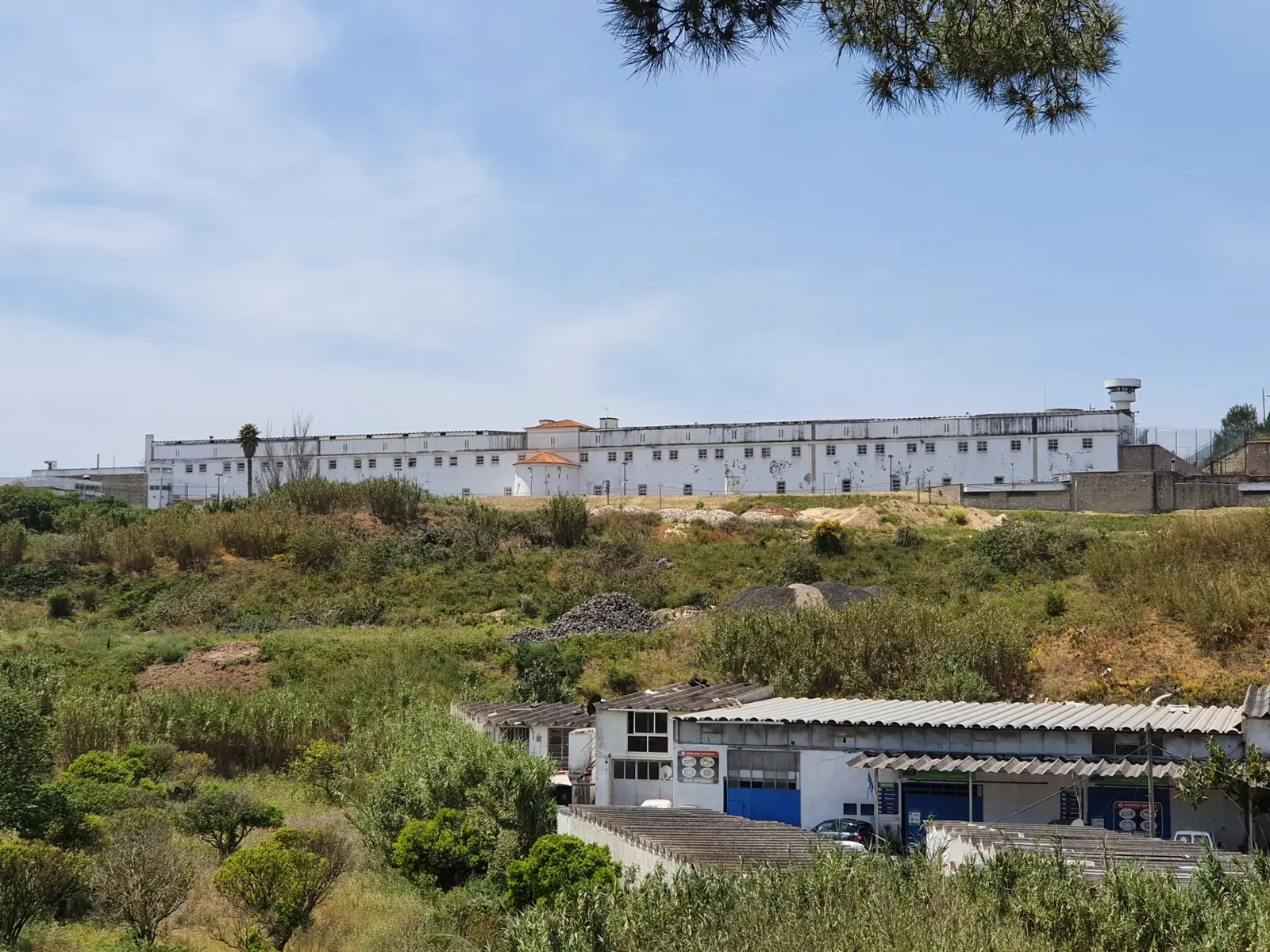
O Forte de Caxias, hoje Estabelecimento Prisional de Caxias, visto da encosta em 2022. GualdimG, CC BY-SA 4.0 At Caxias the political police resisted, and the release was delayed: the National Salvation Junta wanted to separate those imprisoned for ideological reasons from those accused of common crimes. “All of us or none” (Ou todos ou ninguém), the prisoners replied. Close to midnight the order came to release them all; they began to walk out at 00:30 on 27 April, and by one in the morning there were no political prisoners left in Caxias.7
Among the women released were the journalists Helena Neves and Elvira Nereu. From 1938, it was in the North Redoubt of this fort that women political prisoners were held on remand and served their sentences.816
What you can see today
A plaque commemorating the release of the political prisoners was unveiled on 26 April 2019, with lines by Manuel Alegre: “I shall pass through the cities / Like the wind over the sands / and open all the windows / and open all the jails” (Hei de passar nas cidades / Como o vento nas areias / e abrir todas as janelas / e abrir todas as cadeias).17 On Estrada da Gibalta, next to Caxias station, a steel sculpture by Sérgio Vicente, unveiled on 10 June 2020, represents the number of prisoners who passed through the fort between 1936 and 1974.1819
Conceição Matos and Domingos Abrantes tell together, in a testimony recorded by the museum on 7 October 2015, of life underground, imprisonment and torture. The museum’s keywords include the Aljube prison, Caxias, the PIDE interrogations and the escape from Caxias.
Original page Licença padrão do YouTube — embed permitido pelo canal oficial do Museu do Aljube
Museu do Aljube Resistência e Liberdade, on YouTube. The player only connects to that site when you press “Watch”.
To stop 3by metro, train or busDirections
Stop 3: 28 April — the train from exile
Avenida Infante D. Henrique / Rua dos Caminhos de Ferro, 1100-094 Lisboa
Today: Santa Apolónia railway station
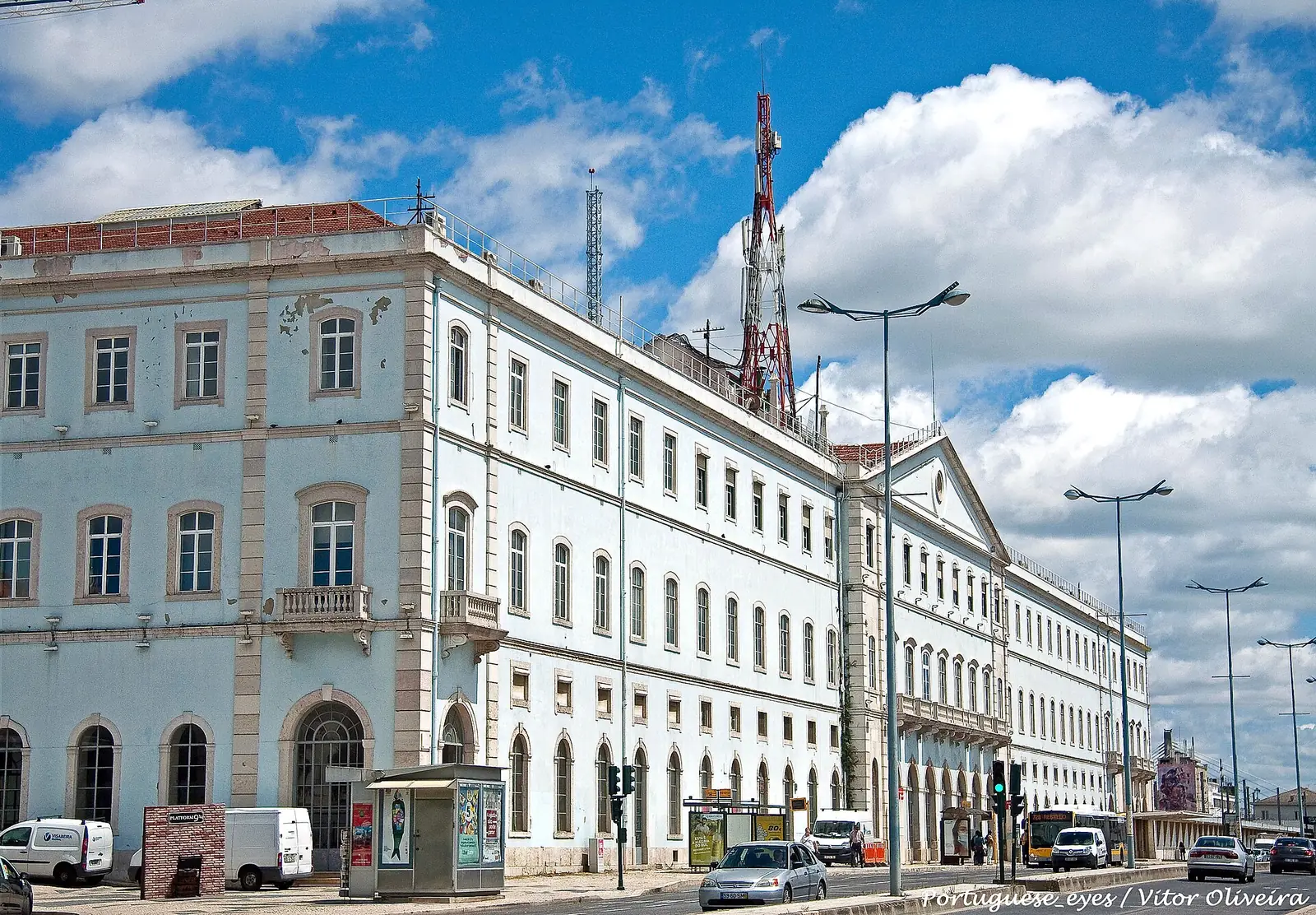
A fachada da Estação de Santa Apolónia, em junho de 2020. Vitor Oliveira, CC BY-SA 2.0 On the 25th, Mário Soares was in Bonn. Three days later he arrived here by train, with Maria Barroso, also a founder of the Socialist Party. A crowd was waiting for them; Soares spoke from a balcony of the station, loudhailer in hand.9 The Casa Comum photographs show Ramos da Costa and Manuel Tito de Morais on the balcony with them.10
The station had seen another crowd before: the one that waited for Humberto Delgado in May 1958, which the GNR dispersed with baton charges through the Baixa.11
What you can see today
A municipal plaque bearing Humberto Delgado’s likeness, unveiled on 16 May 2008.
- 28 Apr 1974Mário Soares chega do exílio a Santa Apolónia
- 16 May 1958Humberto Delgado arrives at Santa Apolónia
Fernanda Gonçalves tells how she heard about the revolution while in Aveiro, arrived the next day at Santa Apolónia on a train full of friends and went on to Caxias, where thousands of people were waiting for the political prisoners to come out. She remembers the passage the crowd kept open for the negotiations with the PIDE, inside.
Original page Licença padrão do YouTube — embed permitido pelo canal oficial da Câmara Municipal de Lisboa
Câmara Municipal de Lisboa, on YouTube. The player only connects to that site when you press “Watch”.
To stop 4by metro, train or busDirections
Stop 4: 30 April — Cunhal returns
Alameda das Comunidades Portuguesas, 1700-111 Lisboa
Today: Humberto Delgado Airport
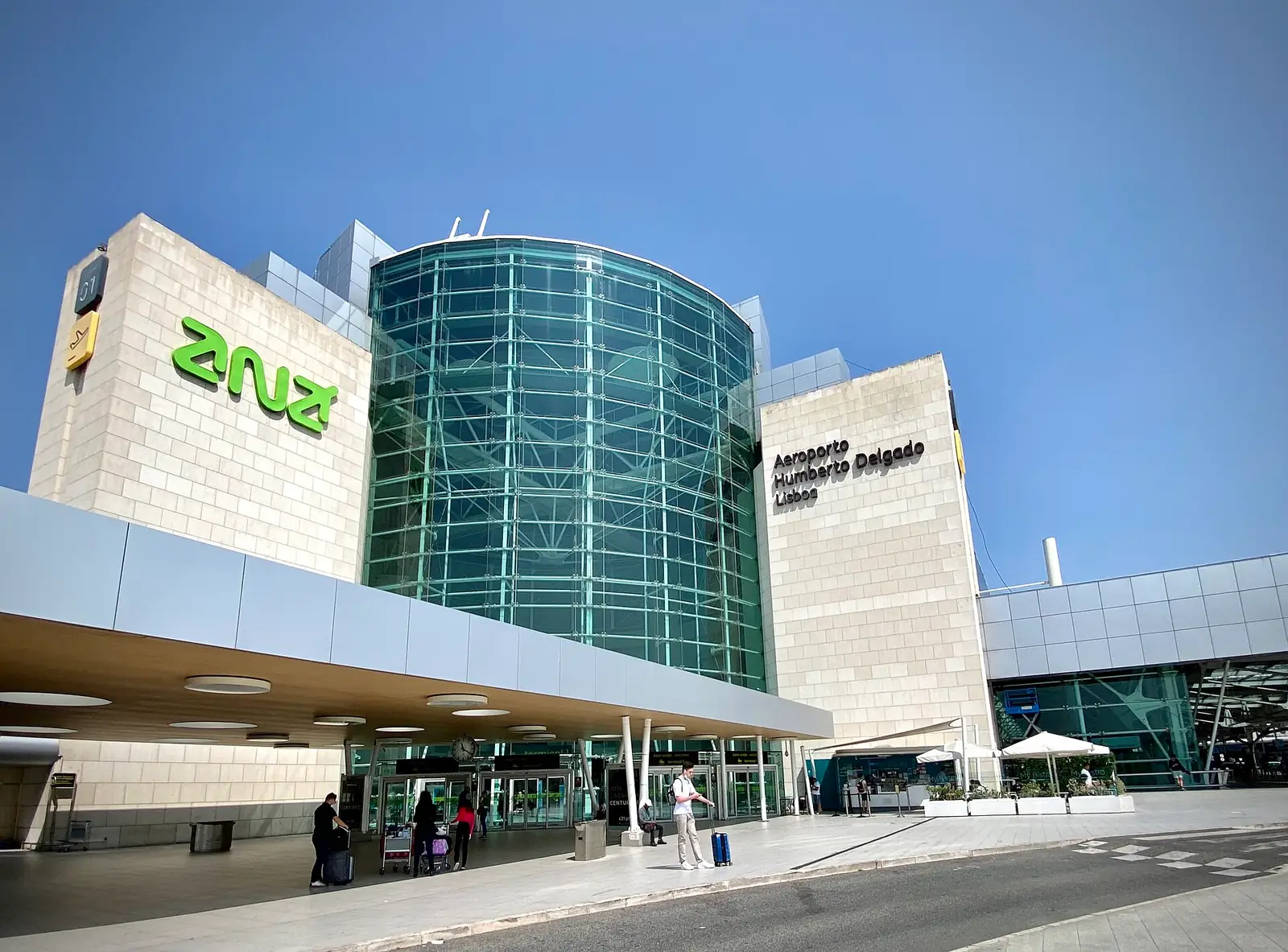
O Terminal 1 do Aeroporto Humberto Delgado, na Portela, em 2021. Sharon Hahn Darlin, CC BY 2.0 In the early hours of 25 April, soldiers from the Infantry Practical School occupied the airport and closed the airspace. On the morning of the 26th, Marcelo Caetano and Américo Tomás left from here on an Air Force plane for Funchal.12
On 30 April Álvaro Cunhal arrived after fourteen years in exile, greeted by a crowd; he climbed onto a Chaimite to speak to it. That day, a communiqué from the National Salvation Junta authorised the return of all political exiles.9
To stop 5by metro, train or busDirections
Stop 5: 1 May 1974 — the city in the streets
Alameda D. Afonso Henriques, 1900-006 Lisboa
Today: Alameda D. Afonso Henriques / the Fonte Monumental (Fonte Luminosa)
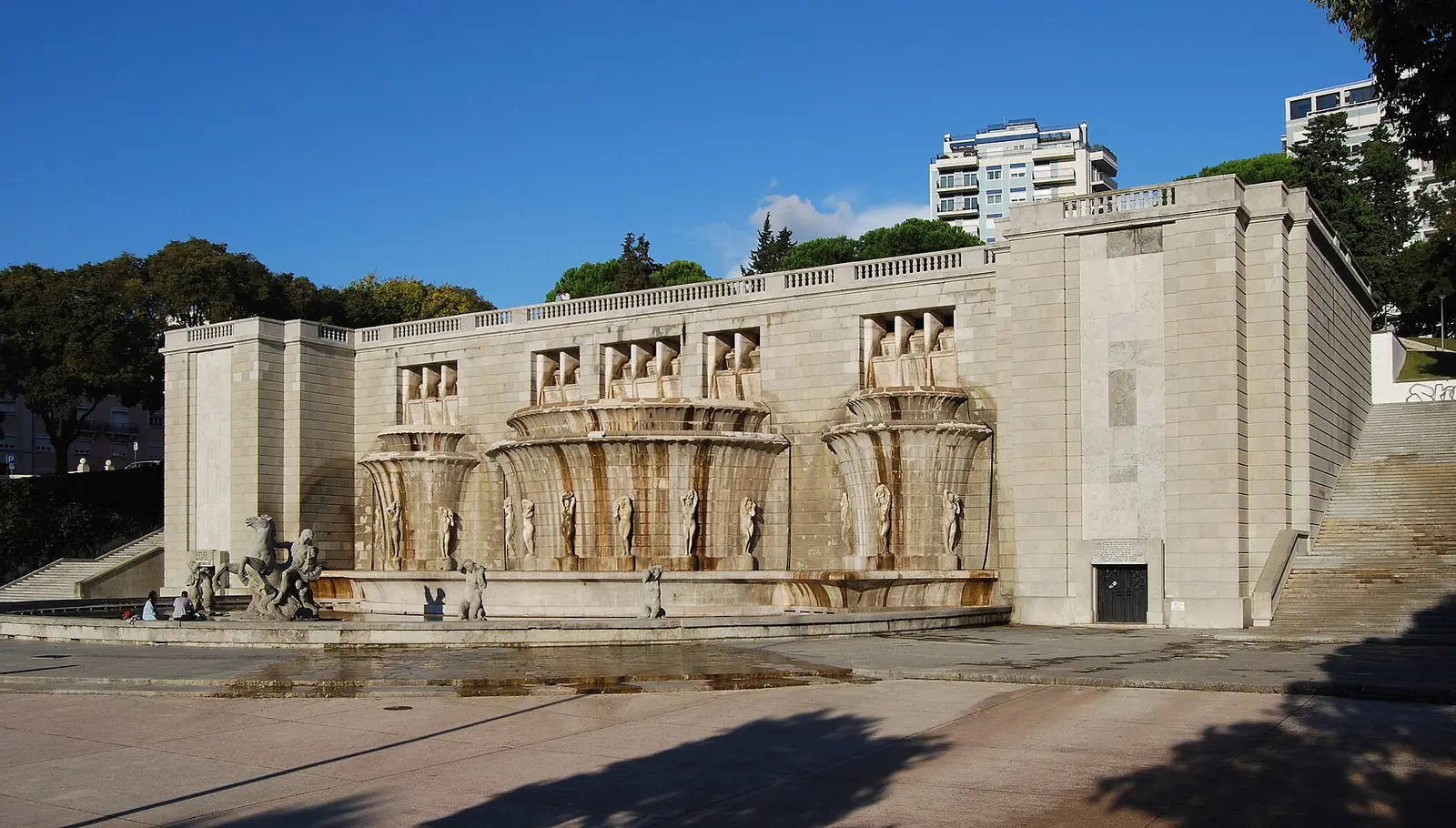
A Fonte Monumental, ou Fonte Luminosa, no topo da Alameda D. Afonso Henriques, em setembro de 2014. Felix König, CC BY 3.0 On 27 April a decree made May Day (1 May) a national holiday — the revolution’s first legal achievement, in the words of the Aljube Museum.1 In Lisbon the march gathered here, on the Alameda, and went on to the stadium of the former FNAT. The Commemorative Commission estimates that around a million people took to the streets across the country; the 25 April Documentation Centre, that around five hundred thousand marched in Lisbon.313
The third chapter of Alfredo Cunha’s film (music by Rodrigo Leão, directed by Miguel Brugo), published by the Commission on 14 February 2024, with photographs from the months that followed the revolution. In the book, this part has a text by Fernando Rosas and includes the rally of the first May Day (1 May) in freedom, at the stadium of the National Foundation for Joy at Work (FNAT).
Original page Licença padrão do YouTube — embed permitido pelo canal oficial da Comissão Comemorativa 50 Anos 25 de Abril
Comissão Comemorativa 50 Anos 25 de Abril, on YouTube. The player only connects to that site when you press “Watch”.
To stop 6by metro, train or busDirections
Stop 6: The renamed stadium
Rua Silva e Albuquerque / Avenida do Rio de Janeiro, 1700-360 Lisboa
Today: Estádio 1.º de Maio
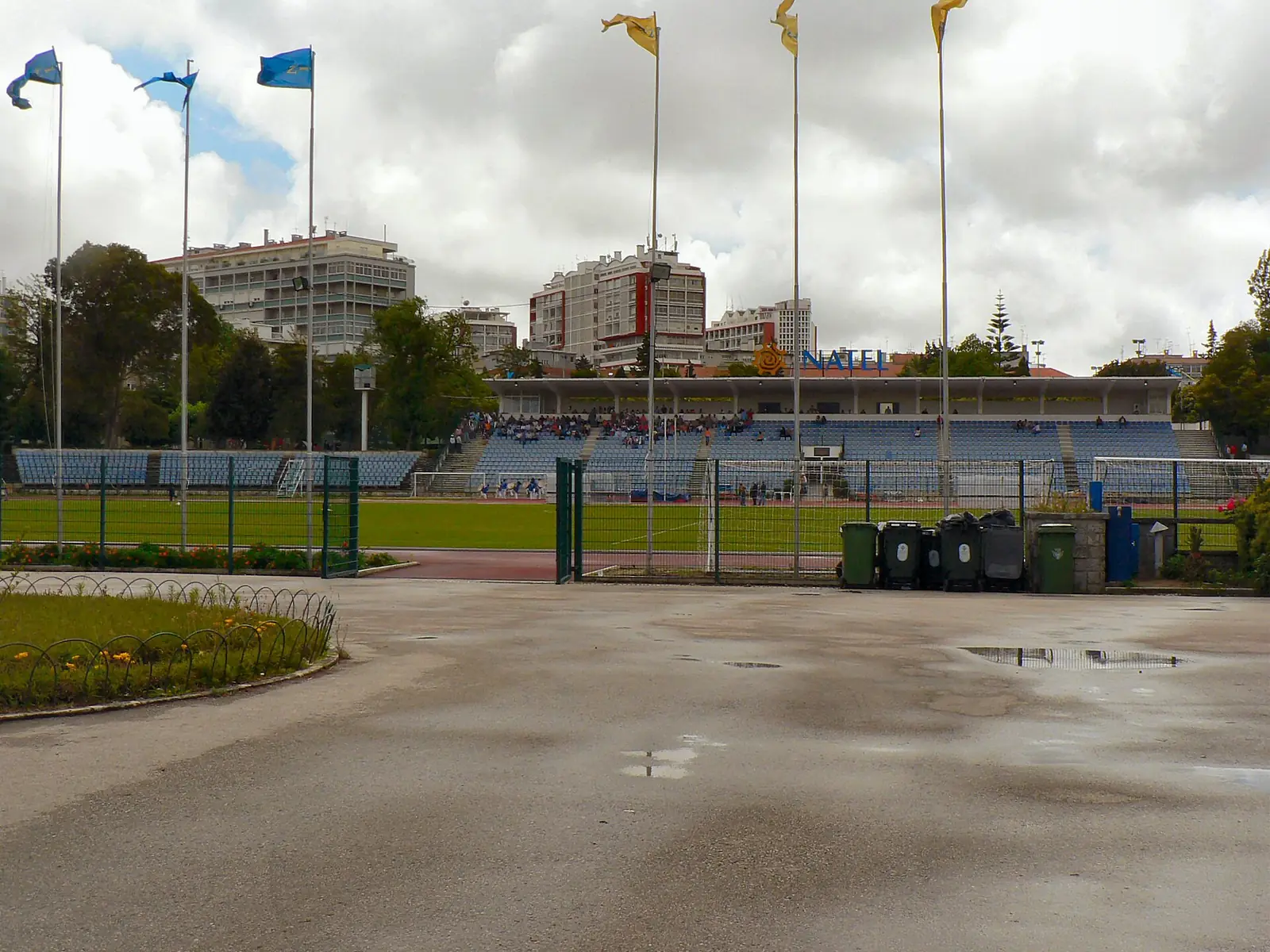
O Estádio 1.º de Maio, do INATEL — o antigo Estádio da FNAT —, em 2007. Paulo Juntas, CC BY-SA 2.5 The stadium belonged to the FNAT, the National Foundation for Joy at Work, a regime body; that day it was renamed Estádio 1.º de Maio (May Day Stadium). Mário Soares and Álvaro Cunhal arrived surrounded by thousands of people and embraced at the rally, under the slogan “Peace, Bread and Freedom” (Paz, Pão e Liberdade). The Commemorative Commission calls it the first and last May Day in unity.3
The third chapter of Alfredo Cunha’s film (music by Rodrigo Leão, directed by Miguel Brugo), published by the Commission on 14 February 2024, with photographs from the months that followed the revolution. In the book, this part has a text by Fernando Rosas and includes the rally of the first May Day (1 May) in freedom, at the stadium of the National Foundation for Joy at Work (FNAT).
Original page Licença padrão do YouTube — embed permitido pelo canal oficial da Comissão Comemorativa 50 Anos 25 de Abril
Comissão Comemorativa 50 Anos 25 de Abril, on YouTube. The player only connects to that site when you press “Watch”.
To stop 7by metro, train or busDirections
Stop 7: The 27 women of the Constituent Assembly
Palácio de São Bento, Largo das Cortes, Lisboa
Today: Assembly of the Republic
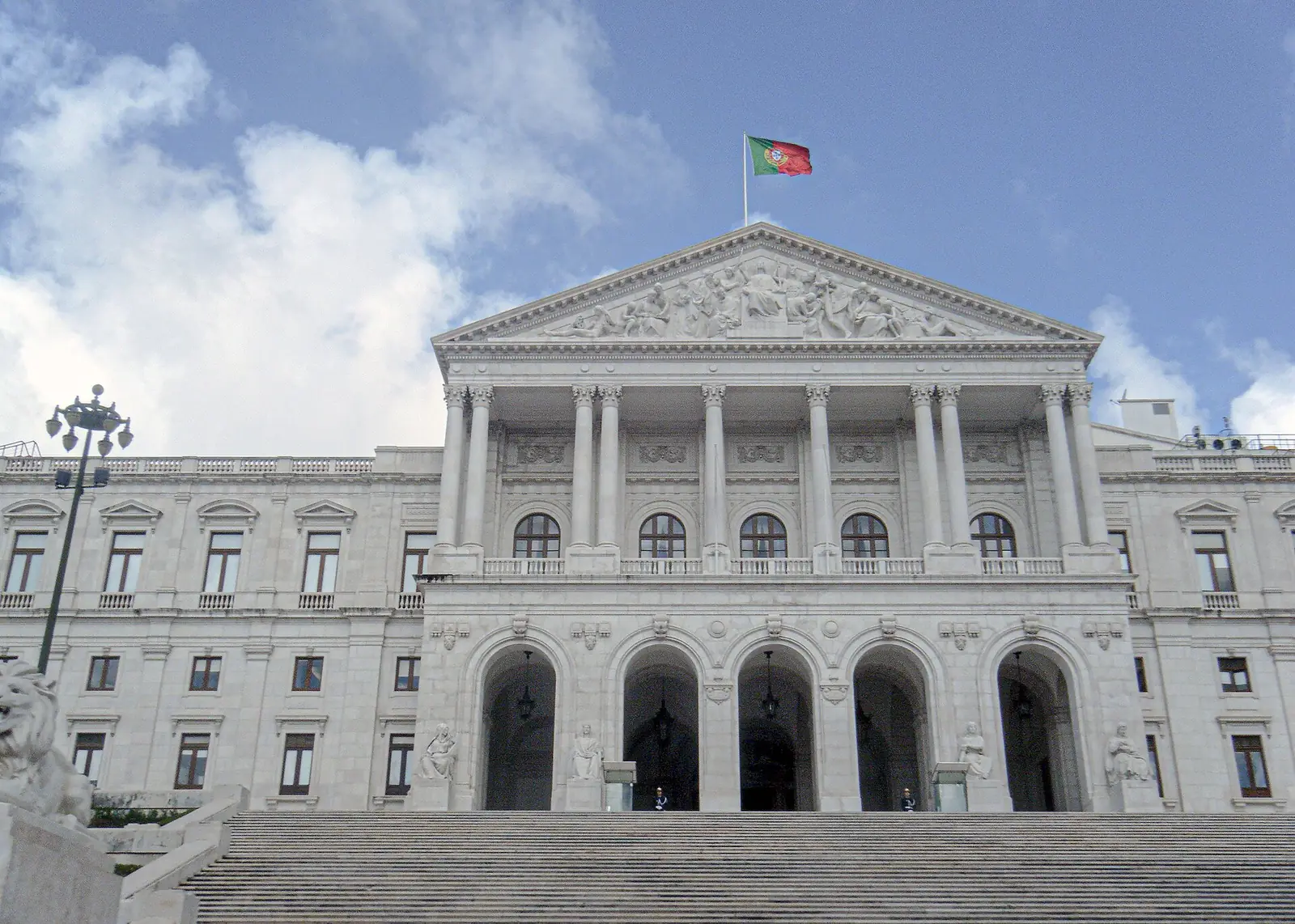
O Palácio de São Bento, sede da Assembleia da República, em junho de 2014. Albarubescens, CC BY-SA 4.0 On 25 April 1975, in the first free elections, twenty women were elected among the 250 deputies to the Constituent Assembly; with resignations and replacements, twenty-seven came to hold a seat, among them Maria Alda Nogueira, Helena Roseta and Sophia de Mello Breyner Andresen. Only six sat on committees, and only one chaired one: Sophia, the committee that drafted the preamble. In the plenary sessions the men were addressed as “Sr. Deputado” (Mr Deputy); the women, often, as “minha senhora” (madam).2
The Constitution approved here on 2 April 1976 forbids, in Article 13, favouring or disadvantaging anyone on grounds of sex, and gives spouses, in Article 36, equal rights and duties.14 The Civil Code had to be revised so that it no longer made the husband the “head of household”.15
What you can see today
Busts of two women deputies: Maria Alda Nogueira, in the cloister (CIG; sculptor António Trindade, according to Wikipedia), and Natália Correia (according to Wikipedia, the only two women deputies with a bust in the Assembly).
- 25 Apr 1975Eleição da Assembleia Constituinte: 20 deputadas
- 2 Jun 1975Sessão inaugural da Assembleia Constituinte
- 12 Nov 1975Trabalhadores da construção civil cercam a Assembleia Constituinte
- 2 Apr 1976Assembleia Constituinte aprova a Constituição da República
A short piece from Parliament’s series “Cápsula do Tempo” (Time Capsule), devoted to the women in the Constituent Assembly of 1975–1976.
Original page Licença padrão do YouTube — embed permitido pelo canal oficial da Assembleia da República
Assembleia da República, on YouTube. The player only connects to that site when you press “Watch”.


.jpg)
,_Lisbon,_Portugal_(51323558287).jpg)


Notes on the sources2
- The date of Mário Soares’s arrival: Sunday 28 April in most of the Casa Comum photographs; another photograph and a blog give 27 April.
- The figures for May Day 1974 (around a million across the country, around five hundred thousand people in Lisbon) are estimates with no primary source given.
Do you know more, or do you have a document? Tell us.
Sources
- 11º de Maio – Dia do Trabalhador. Museu do Aljube Resistência e Liberdade (EGEAC) — consulted on 2 October 2026
- 2As mulheres na Constituinte de 1975-1976. Assembleia da República — consulted on 2 October 2026
- 3Operação Viragem Histórica. Comissão Comemorativa 50 Anos 25 de Abril — consulted on 2 October 2026
- 4Núcleo Museológico do Posto de Comando do Movimento das Forças Armadas (PCMFA). Câmara Municipal de Odivelas — consulted on 2 October 2026
- 5Cronologia do 25 de Abril, por Jofre Alves (blogue Abril de Novo, 2010), na Biblioteca Digital do CD25A. Centro de Documentação 25 de Abril – Universidade de Coimbra — consulted on 2 October 2026
- 6Movimentações do dia 25 de Abril. Associação 25 de Abril — consulted on 2 October 2026
- 7Álvaro Arranja, «A libertação dos presos políticos na revolução de Abril». Esquerda.net — consulted on 2 October 2026
- 8Cárceres do império. Memória Comum – Memorial aos Presos e Perseguidos Políticos — consulted on 2 October 2026
- 9O regresso dos exilados. Associação 25 de Abril — consulted on 2 October 2026
- 10Chegada de Mário Soares do exílio, em Santa Apolónia (fotografia, cota 10182.129). Casa Comum – Fundação Mário Soares e Maria Barroso — consulted on 2 October 2026
- 11Delgado: Um vendaval varreu o País (João Paulo Guerra). esquerda.net — consulted on 2 October 2026
- 12Aeroporto de Lisboa (Lugares de Abril). Associação 25 de Abril — consulted on 2 October 2026
- 13O 25 de Abril para os mais novos – Cronologia hora a hora. Centro de Documentação 25 de Abril – Universidade de Coimbra — consulted on 2 October 2026
- 14Constituição da República Portuguesa – texto originário, aprovado em 2 de abril de 1976. Assembleia da República — consulted on 2 October 2026
- 15A revisão do Código Civil e os Direitos das Mulheres (1977). Assembleia da República — consulted on 2 October 2026
- 16Forte de Caxias (Prisões da Ditadura). Comissão Comemorativa 50 Anos 25 de Abril — consulted on 2 October 2026
- 17Evocação da Libertação dos Presos Políticos da Prisão de Caxias. Museu do Aljube Resistência e Liberdade (26/4/2019) — consulted on 2 October 2026
- 1810 de Junho. Oeiras inaugura escultura evocativa da libertação dos presos de Caxias. Observador (8/6/2020) — consulted on 2 October 2026
- 19A fuga de Caxias, um acto de resistência antifascista rumo à vitória, foi há 60 anos. URAP – União de Resistentes Antifascistas Portugueses — consulted on 2 October 2026
Other walks

Revolution · on foot
The first day
25 April 1974 hour by hour, from the Terreiro do Paço to the Carmo and the door of the political police
- Distance
- 2.4 km
- Duration
- 1 h 30 min
- Stops
- 7 stops
- Difficulty
- Moderate

Women · on foot
Graça, the women’s hill
Seamstresses on strike, a republican propagandist, a women’s prison, a bar and a poet — Graça as they tell it
- Distance
- 1.7 km
- Duration
- 1 h 15 min
- Stops
- 6 stops
- Difficulty
- Demanding

Repression · on foot
The Estado Novo, explained
How a dictatorship lasted 48 years: the leader, the façade, the single party, the family, work and propaganda — from São Bento to Restauradores
- Distance
- 4.6 km
- Duration
- 2 h 20 min
- Stops
- 9 stops
- Difficulty
- Moderate