Walk · Women · on foot
Graça, the women’s hill
Seamstresses on strike, a republican propagandist, a women’s prison, a bar and a poet — Graça as they tell it
- Distance
- 1.7 km
- Duration
- 1 h 15 min
- Stops
- 6
- Difficulty
- Demanding
The walk, the photos and the map stay on the phone, to open anywhere.
Introduction
Mouraria and Graça hold a history that is almost all women’s. Here there were seamstresses who went on strike in 1915 for an eight-hour day;1 a republican propagandist who died the day after the State granted her the pension the monarchy had refused her;2 a women’s prison; a bar where Natália Correia gathered her circle; and the house where Sophia de Mello Breyner Andresen lived for more than fifty years.4
The route climbs from the Benformoso to Graça and ends at the viewpoint named after the poet, with Lisbon at your feet.
Before you go
- Start
- Rua do Benformoso, near Largo do Intendente — Metro Intendente or Martim Moniz (green line)
- Finish
- Sophia de Mello Breyner Andresen viewpoint, in Graça — Tram 28 (Graça stop)
- Accessibility of the route
- It begins with a long, hard climb, from the Benformoso to Rua de São Gens, with very steep stretches and cobbles. After that, Graça is almost flat. If you cannot manage the climb, you can take tram 28 from Martim Moniz to Largo da Graça and start at the Botequim; the first two stops can be read on your phone.
This walk in dates
Aug 1915
1 Aug 1917
17 Oct 1924
6 Aug 1936
6 more dates
28 Jan 1949
10 Feb 1949
14 Oct 1949
31 Dec 1968
1969
1971
Map of the walk “Graça, the women’s hill”, with 6 numbered stops. The list of stops follows the map.
The stops
Stop 1: 1915 — the Ramiro Leão seamstresses
Rua do Benformoso, Lisboa (número por identificar)
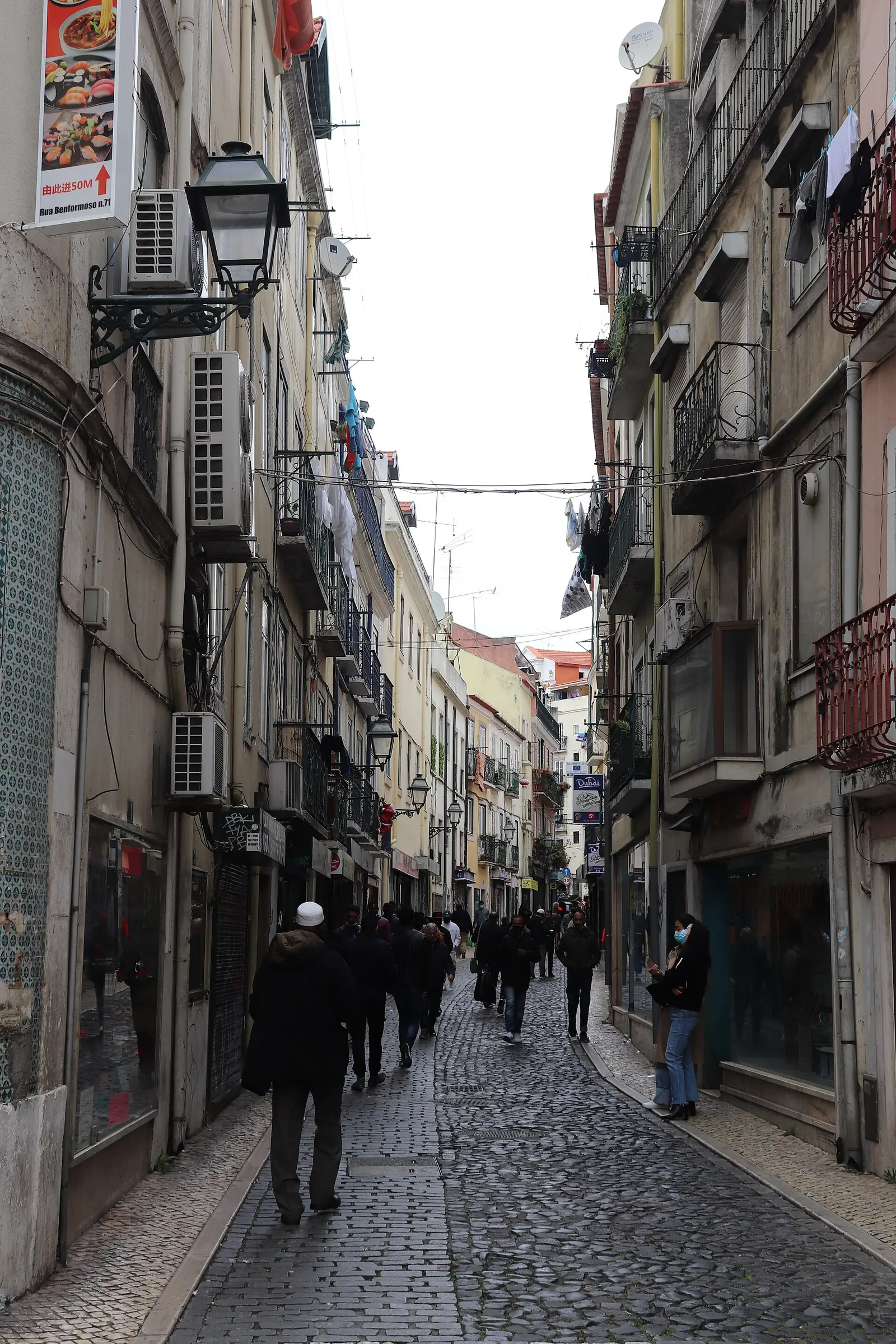
A Rua do Benformoso, entre a Mouraria e o Intendente, em abril de 2022. Andrzej Otrębski, CC BY-SA 4.0 In 1915 this street was home to the trade association of the Seamstresses and Stitchers. That summer, A Voz do Operário (The Worker’s Voice) published a letter from the father of a seamstress at the factory that the Chiado firm Ramiro Leão had on the Santana hill: the women workers paid for the thread they used and earned between 185 and 220 centavos a week. Adelaide Abrantes, a leader of the association, replied: the boss would not treat them like that if they were organised, “for without a boss one can still produce, but it is the boss who cannot live without the producers”. More than a hundred women workers came to the meeting she called here.
In August, three women workers who had asked for the eight-hour day — Miquelina Furtado, Laurinda Pinheiro and Lúcia Martins — were dismissed. Their colleagues picketed the factory gate before six in the morning and brought it to a halt; after four and a half hours, GNR cavalry and infantry dispersed them. The strike was lost, but the eight-hour law came in 1919.1
To stop 2670 m · 10 min on footDirections
Stop 2: Angelina Vidal, the propagandist
Rua de São Gens, 41, 1170-337 Lisboa
Today: A small single-storey house
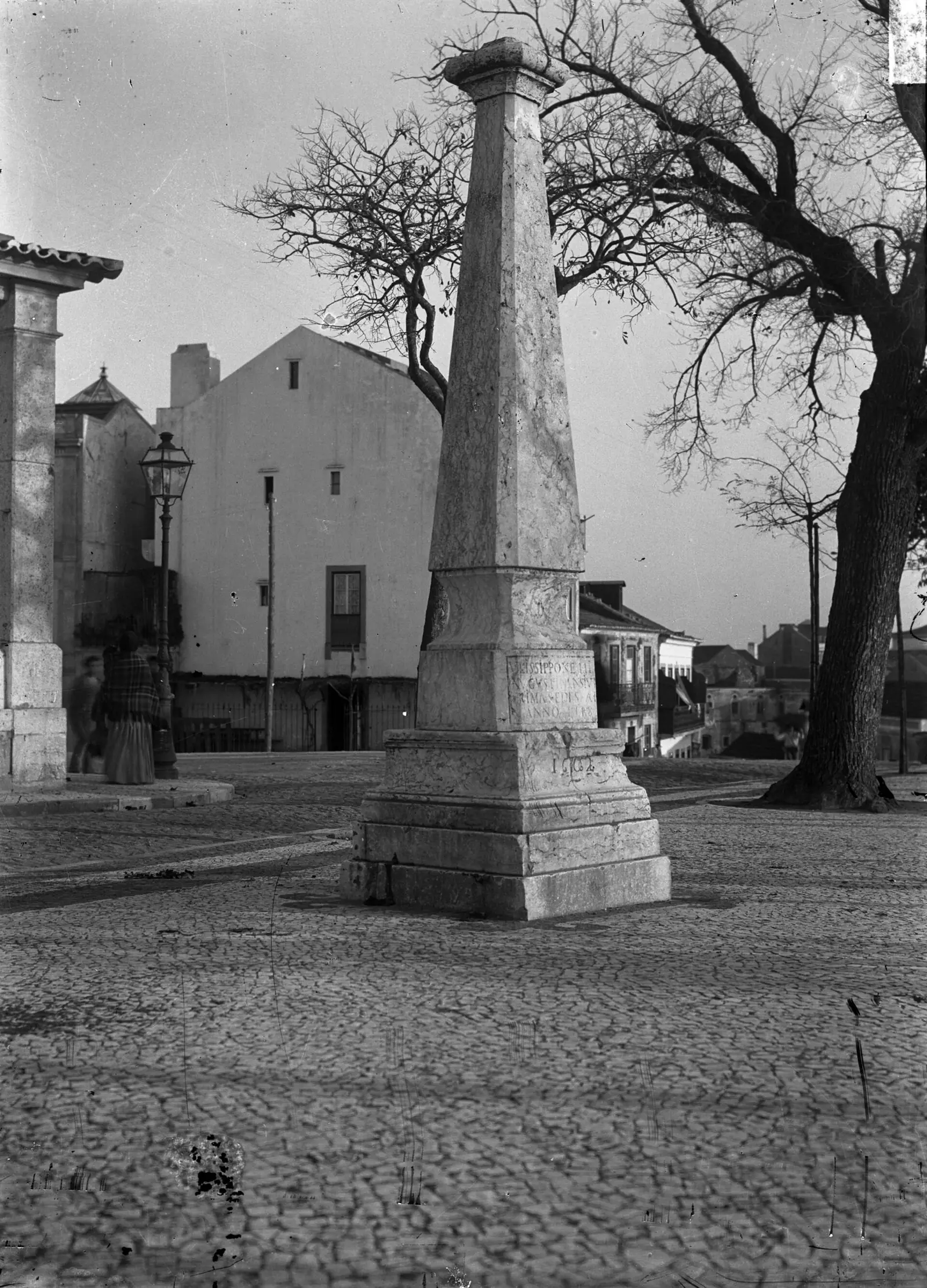
O padrão de 1148 na Rua de São Gens, por volta de 1900. Fotografia de José Artur Leitão Bárcia (Arquivo Municipal de Lisboa). José Artur Leitão Bárcia, Public domain Angelina Vidal (1847–1917) spoke at rallies and wrote in workers’ newspapers for the Republic and for socialism; she was editor of A Voz do Operário and taught French and music. She championed equality between men and women at work and in civil law, although she never called herself a feminist.
A Navy doctor’s widow since 1894, she saw the monarchy refuse her a pension for being an “enemy of the institutions”. The pension was granted on 31 July 1917 — and Angelina died the next day, here, at No. 41 Rua de São Gens.2 In 1924 Lisbon gave her name to a street nearby, with the caption “Illustrious Lecturer and Propagandist for Social Emancipation” (Ilustre Conferencista e Propagandista da Emancipação Social).3
To stop 3560 m · 10 min on footDirections
Stop 3: Natália’s bar
Largo da Graça, 79-80 (rés-do-chão da Vila Sousa), 1100-266 Lisboa
Today: Botequim bar (reopened in 2010 by new owners)
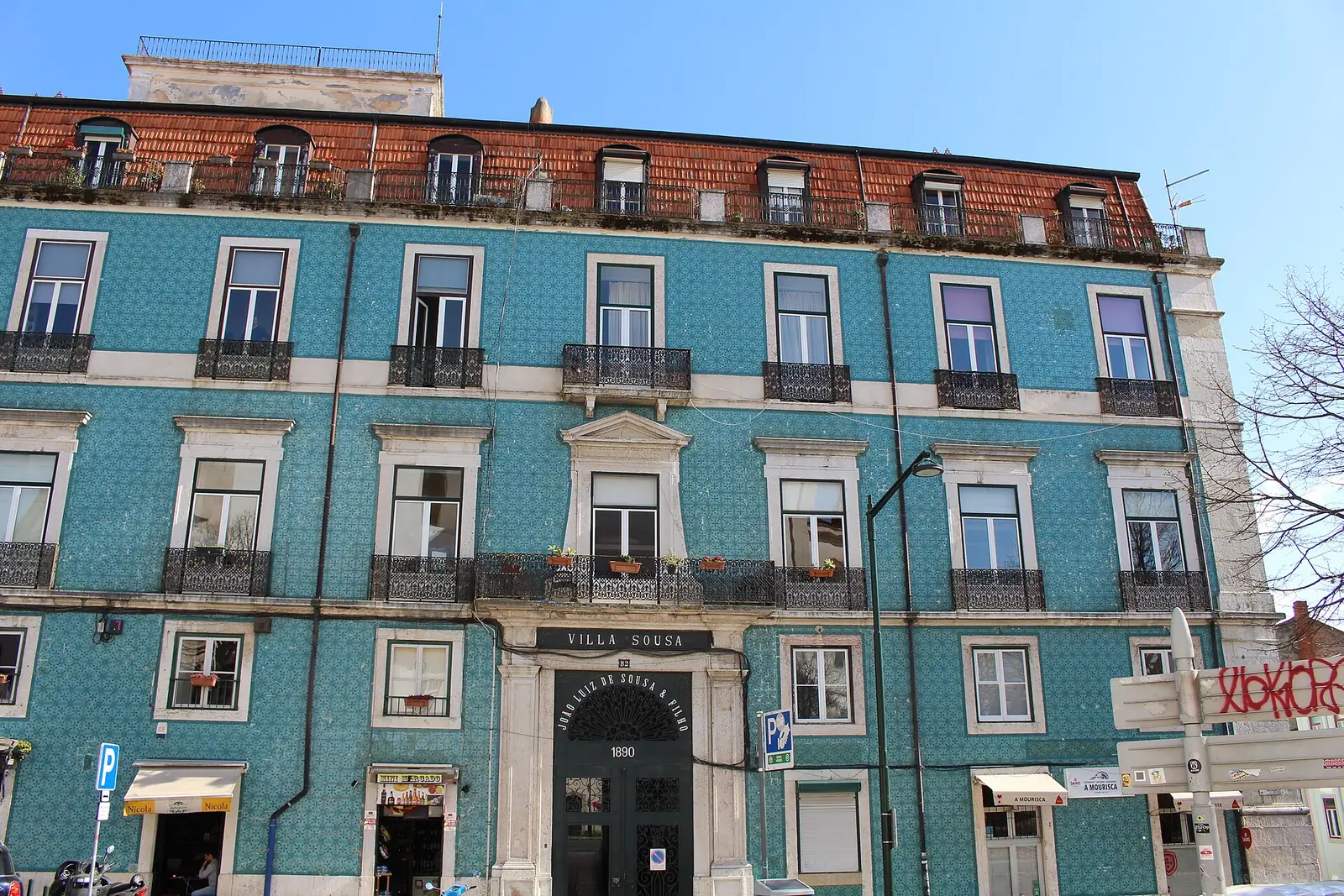
A Vila Sousa, no Largo da Graça, em cujo rés-do-chão fica o Botequim, em 2019. Chabe01, CC BY-SA 4.0 In 1971 Natália Correia opened a bar here with three friends — Isabel Meireles, Júlia Marenha and Helena Roseta — and brought here the circle she used to host at home, with people from the arts, from letters and from the opposition.5 People discussed, says a walking guide from the NOVA School of Social Sciences and Humanities (NOVA FCSH), “literature, politics and feminism in freedom”.6
Natália, already convicted over the anthology of erotic and satirical poetry she had edited, was here on the night of 24–25 April 1974, and it was here that she celebrated the fall of the dictatorship.7
To stop 4200 m · 5 min on footDirections
Stop 4: The workers’ school
Rua da Voz do Operário, 13, 1100-620 Lisboa
Today: A Voz do Operário Education and Welfare Society
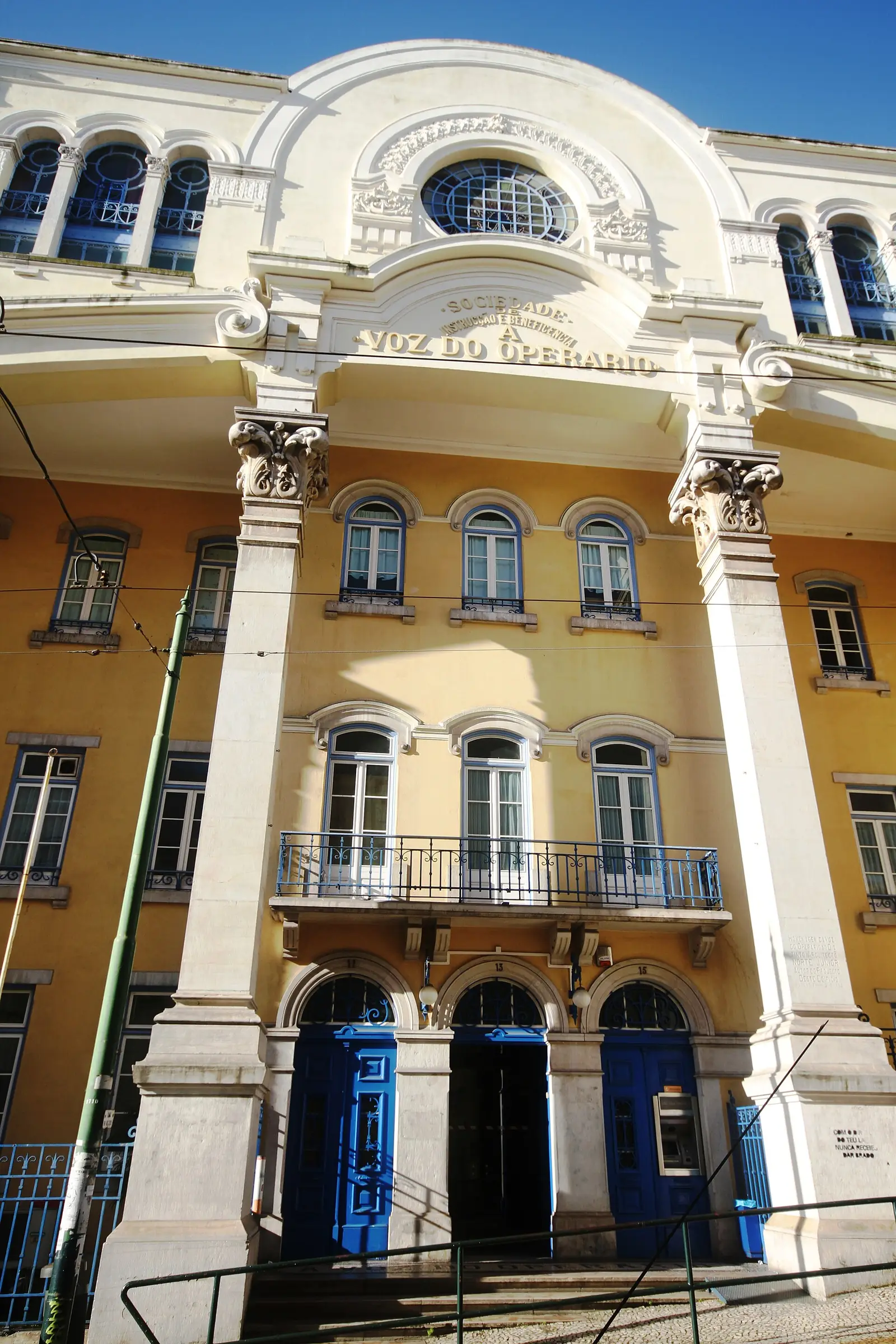
A sede da Sociedade de Instrução e Beneficência A Voz do Operário, na Graça, em 2013. José Luiz Bernardes Ribeiro, CC BY-SA 3.0 Founded in 1879 as the tobacco workers’ newspaper, A Voz do Operário became the largest popular school in Lisbon: in 1938 it had 4,200 pupils, most of them workers’ children.8
In 1949 the opposition held rallies here for Norton de Matos’s presidential candidacy — and women sat at the top table: Isabel Aboim Inglez, Maria Lamas and the doctor Cesina Bermudes, leaders of the women’s movement that supported the general.9 In October that year Cesina Bermudes was arrested and taken to Caxias;10 Maria Lamas would be arrested three times.11
- 28 Jan 1949Norton de Matos rally at the Voz do Operário
- 10 Feb 1949Norton de Matos campaign rally at the Voz do Operário, with Maria Lamas and Cesina Bermudes
- 14 Oct 1949Arrest of Cesina Bermudes, a leader of the National Democratic Women’s Movement
To stop 5290 m · 5 min on footDirections
Stop 5: The women’s prison
Travessa das Mónicas, 2, 1100-359 Lisboa
Today: The former Convent of Santa Mónica
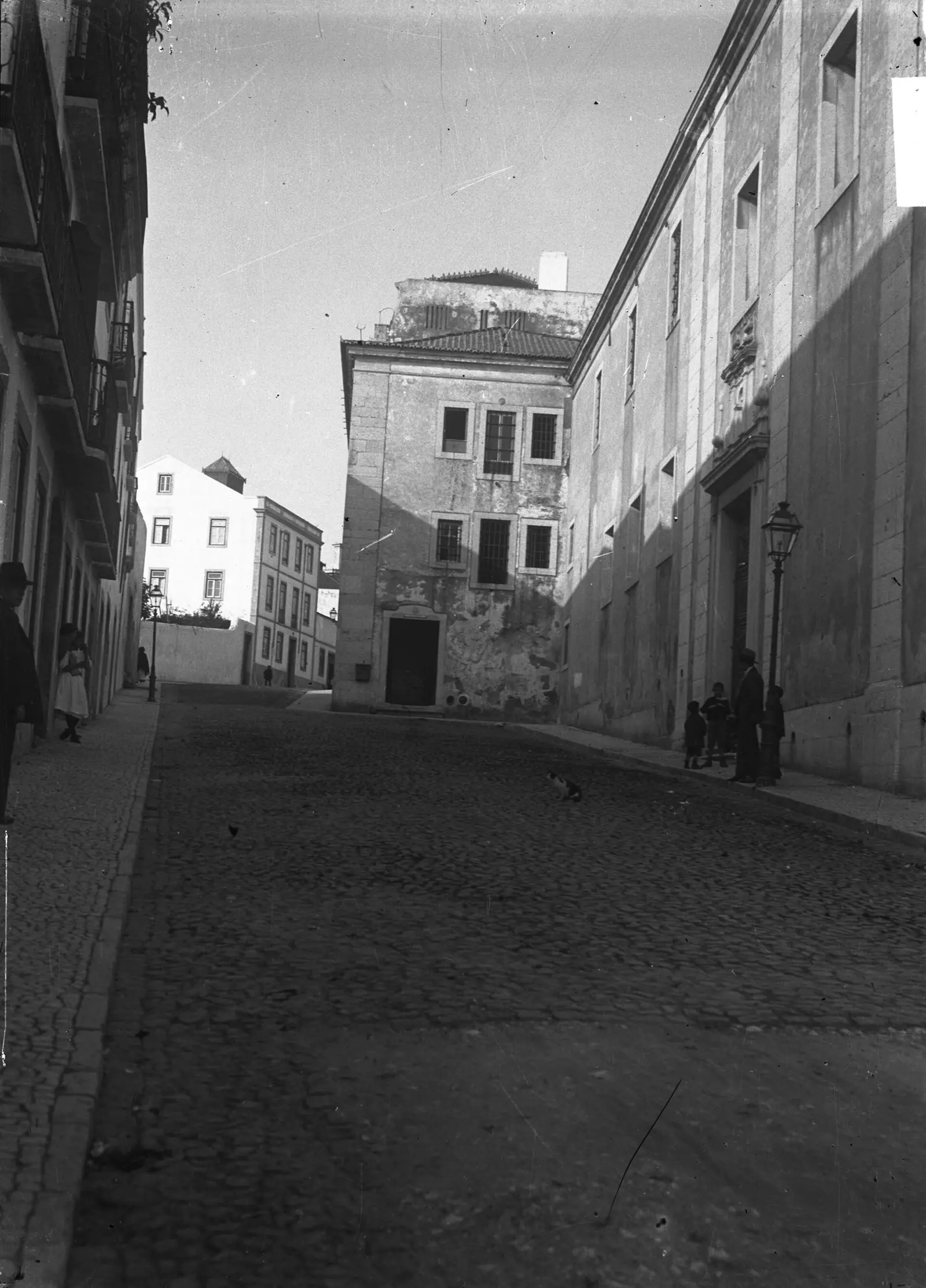
A Travessa das Mónicas e o Convento das Mónicas, já estabelecimento prisional, por volta de 1900. Fotografia de José Artur Leitão Bárcia (Arquivo Municipal de Lisboa). José Artur Leitão Bárcia, Public domain This former convent housed Lisbon’s Civil Prison for Women. It held mainly common criminals, but it also took in women political prisoners.12 Magda Fonseca remembers visiting her aunt, a communist activist, here as a child: the “apalpadeiras” (the women who frisked visitors) at the entrance, the half-height mesh between prisoners and visitors, the uniforms — “little blue and white checks for the political ones, and red and white for the common prisoners” — and the notes hidden in the child’s underwear.13
It was here that the Plenary Court sent Isabel Aboim Inglez for three days, for “lack of respect for the court”. On her way out, she said she had learnt from the other women prisoners and carried out a “sociological study”.14
To stop 610 m · 5 min on footDirections
Stop 6: Sophia’s house
Travessa das Mónicas, 57, 1.º andar, Lisboa
A Travessa das Mónicas e o Convento das Mónicas, já estabelecimento prisional, por volta de 1900. Fotografia de José Artur Leitão Bárcia (Arquivo Municipal de Lisboa). José Artur Leitão Bárcia, Public domain On 3 November 1951 Sophia de Mello Breyner Andresen moved with her family to the first floor of No. 57 in this lane. “I’m in Graça! I arrived today,” she wrote to her mother. She lived here until her death in 2004. The house had two sides: one facing the river and the other facing Travessa das Mónicas, “where there was a prison”.4
From here came a resistance made of poems and of deeds: support for Humberto Delgado, the National Commission for Aid to Political Prisoners, the Catholic vigils against the colonial war.15 At the end of the street, the Graça viewpoint has borne her name since 2009, with a bust and a plaque bearing the poem “Lisboa”.16


Notes on the sources1
- The street number of the seamstresses’ former headquarters on Rua do Benformoso; the stop is placed on the street.
Do you know more, or do you have a document? Tell us.
Sources
- 1Greve de operárias da Ramiro Leão em 1915 (Luís Carvalho, 4/9/2019). A Voz do Operário — consulted on 2 October 2026
- 2A republicana Angelina Vidal. Toponímia de Lisboa (Câmara Municipal de Lisboa) — consulted on 2 October 2026
- 3Lisboa Republicana: topónimos no feminino. Toponímia de Lisboa (Câmara Municipal de Lisboa) — consulted on 2 October 2026
- 4Sophia de Mello Breyner Andresen – Lisboa (exposição virtual). Biblioteca Nacional de Portugal — consulted on 2 October 2026
- 5Natália Correia. Museu do Aljube Resistência e Liberdade (EGEAC) — consulted on 2 October 2026
- 6Graça em estado de graça (roteiro, 20/4/2017). FCSH+Lisboa – NOVA FCSH — consulted on 2 October 2026
- 7O Essencial sobre Natália Correia (Luiz Fagundes Duarte). Imprensa Nacional, 2024 — consulted on 2 October 2026
- 8História. A Voz do Operário — consulted on 2 October 2026
- 9Candidatura de Norton de Matos [...] comício de Lisboa (Voz do Operário). Maria Lamas, Manuel João da Palma Carlos e Cesina Bermudes – fotografia (cota 04654.000.026). Casa Comum – Fundação Mário Soares e Maria Barroso — consulted on 2 October 2026
- 10A Rua Cesina Adães Bermudes e o parto sem dor. Toponímia de Lisboa (blogue da Câmara Municipal de Lisboa) — consulted on 2 October 2026
- 11Maria Lamas. Museu do Aljube Resistência e Liberdade (EGEAC) — consulted on 2 October 2026
- 127. Isolamento e «celas disciplinares». Memória Comum – Memorial aos Presos e Perseguidos Políticos — consulted on 2 October 2026
- 13Mónicas (testemunho de Magda Fonseca). URAP – União de Resistentes Antifascistas Portugueses — consulted on 2 October 2026
- 14Isabel Aboim Inglez. Museu do Aljube Resistência e Liberdade (EGEAC) — consulted on 2 October 2026
- 15Sophia de Mello Breyner Andresen: militância antifascista a partir da crise do Estado Novo (tese de doutoramento, Eloísa da Silva Aragão, 2017). Universidade de São Paulo — consulted on 2 October 2026
- 16Um itinerário para Sophia (Luís Almeida D'Eça, 8/11/2019). Agenda Cultural de Lisboa (agendalx.pt) — consulted on 2 October 2026
- 17Rua de São Gens (Roteiro «Voz do Operário»). Instituto de História Contemporânea – NOVA FCSH (DHLAB) — consulted on 3 October 2026
- 18Angelina Vidal: uma desfavorecida que defendeu os desfavorecidos. FCSH+Lisboa – NOVA FCSH, 2017 — consulted on 3 October 2026
Other walks

Revolution · on foot
The first day
25 April 1974 hour by hour, from the Terreiro do Paço to the Carmo and the door of the political police
- Distance
- 2.4 km
- Duration
- 1 h 30 min
- Stops
- 7 stops
- Difficulty
- Moderate

Repression · on foot
The Estado Novo, explained
How a dictatorship lasted 48 years: the leader, the façade, the single party, the family, work and propaganda — from São Bento to Restauradores
- Distance
- 4.6 km
- Duration
- 2 h 20 min
- Stops
- 9 stops
- Difficulty
- Moderate

Revolution · on foot
The figures of April
From the Aljube to São Bento, the lives of Soares, Cunhal and Salgueiro Maia — and those of Maria Barroso, Sofia Ferreira, Natália Correia and Pintasilgo
- Distance
- 3.5 km
- Duration
- 1 h 40 min
- Stops
- 6 stops
- Difficulty
- Moderate