Walk · Repression · on foot
The machinery of repression
The prison, the court, the lock-ups, the police, censorship and propaganda — the dictatorship fitted into a kilometre and a half
- Distance
- 2.3 km
- Duration
- 1 h 25 min
- Stops
- 6
- Difficulty
- Moderate
The walk, the photos and the map stay on the phone, to open anywhere.
Introduction
The dictatorship was not held up by the police alone. It needed prisons where prisoners waited months for trial, courts with judges chosen by the Minister of Justice, censors who cut the news before it reached the page, and a propaganda machine to tell the official version.1
In Lisbon, almost all of it fitted into a kilometre and a half, between the cathedral and Restauradores. This route goes door to door past the Aljube Prison, the Boa-Hora court, the cells of the Lisbon Civil Government, the headquarters of the political police, the censorship office and the palace of propaganda — and tells, at each one, what was done there to women and what women did there.
Before you go
- Start
- Aljube Museum, Rua de Augusto Rosa (next to the cathedral) — Tram 28 (Sé stop); Metro Terreiro do Paço or Baixa-Chiado, ten minutes’ walk away
- Finish
- Palácio Foz, Praça dos Restauradores — Metro Restauradores (blue line); trains at Rossio
- Accessibility of the route
- From the Aljube down to the Baixa it is downhill; from the Baixa up to the Chiado you climb the steep Rua Nova do Almada. The end, from Rua da Misericórdia to Restauradores, is the descent of the Calçada da Glória, very steep and cobbled. Narrow pavements on Rua Capelo and Rua António Maria Cardoso.
This walk in dates
5 Dec 1932
25 Sep 1933
1 May 1964
21 Apr 1965
4 more dates
25 Oct 1973
25 Apr 1974
26 Apr 1974
7 May 1974
Map of the walk “The machinery of repression”, with 6 numbered stops. The list of stops follows the map.
The stops
Stop 1: The prison of the “curros”
Rua de Augusto Rosa, 42, 1100-059 Lisboa
Today: Aljube Museum – Resistance and Freedom
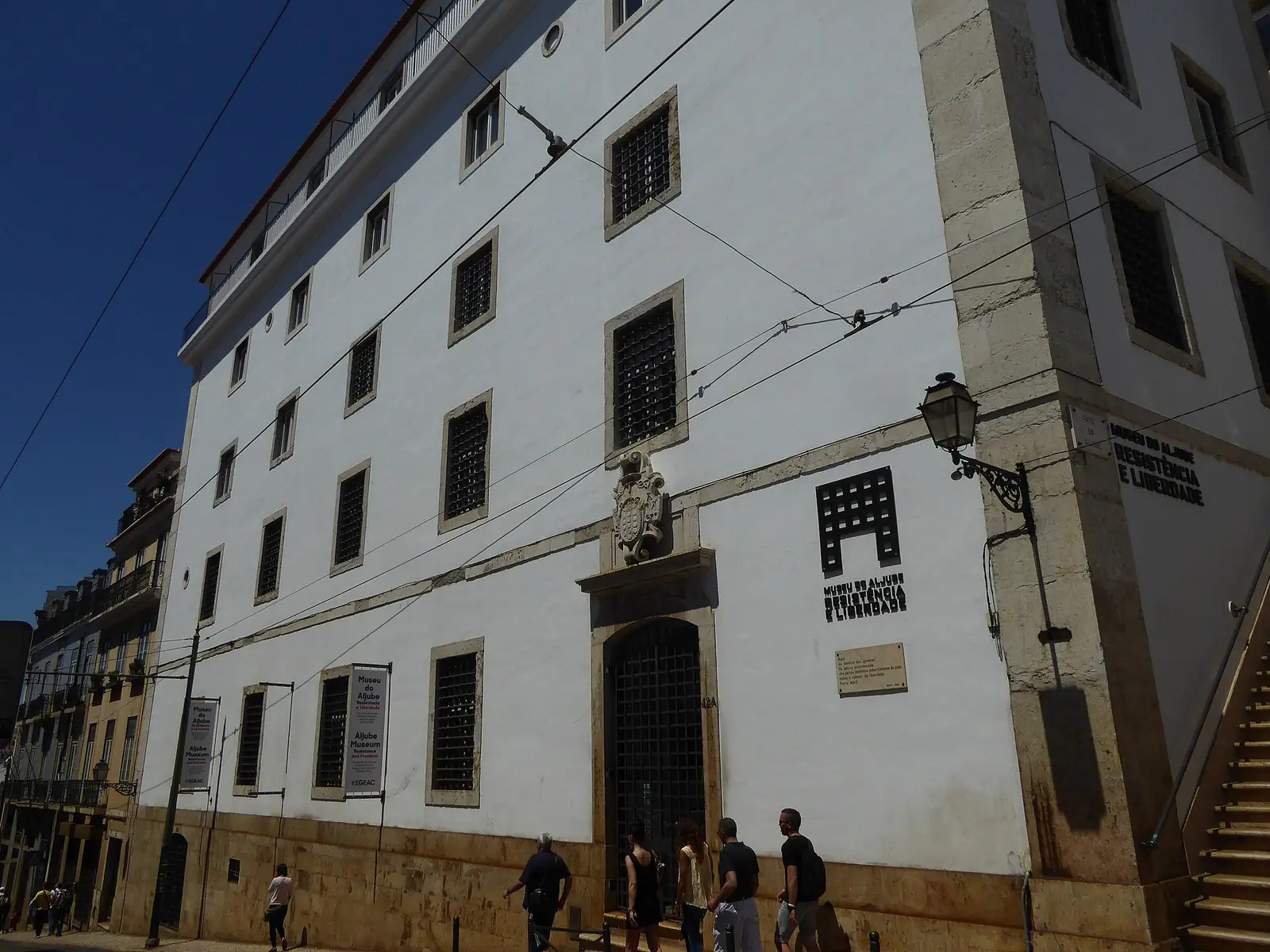
O antigo Aljube, hoje Museu do Aljube – Resistência e Liberdade, na Rua de Augusto Rosa, em maio de 2017. Ardfern, CC BY-SA 4.0 From 1928, the Aljube was a political prison — for men only. It was the prison for those on remand: here they waited for the investigation of their case, for trial or for deportation, and from here they were taken for interrogation at police headquarters.2
From 1943, on the second floor, thirteen isolation cells about a metre wide — the “curros” (pens) — held prisoners in half-darkness, with no paper, no books, no watch, during the first months of incommunicado detention.3 Women arrested by the political police went to the Mónicas Prison, in Graça, and later to Caxias. Since 25 April 2015, the building has been the Aljube Museum – Resistance and Freedom.4
What you can see today
The building itself is the museum. The main door of the former prison is closed, but kept as a testimony of the prison.
A documentary edited by Sofia Gomes for the exhibition “Women and Resistance – New Portuguese Letters and other struggles” (“Mulheres e Resistência – Novas Cartas Portuguesas e outras lutas”), with excerpts from the testimonies the Aljube Museum has been recording since 2015: sixteen women talk about resistance to the dictatorship and the struggle for women’s rights. This version has Portuguese Sign Language (LGP) interpretation; the version without LGP is on the same channel (XmUbNbnHgKg, 2022).
Original page Licença padrão do YouTube — embed permitido pelo canal oficial do Museu do Aljube
Museu do Aljube Resistência e Liberdade, on YouTube. The player only connects to that site when you press “Watch”.
To stop 2720 m · 10 min on footDirections
Stop 2: The court that condemned
Largo da Boa-Hora / Rua Nova do Almada, Chiado, 1249-099 Lisboa (OpenStreetMap: «Convento da Boa Hora», Largo da Boa-Hora, 15)
Today: Former court, closed since 2009
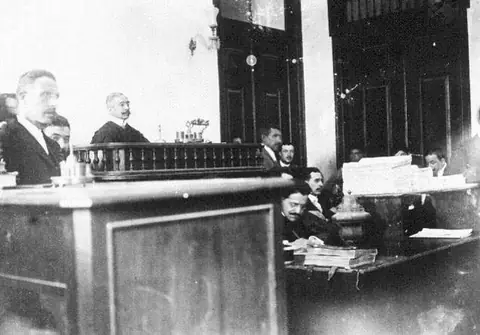
Julgamento no Tribunal da Boa-Hora, em 1909, dos acusados do incêndio da Rua da Madalena. Fotografia de Joshua Benoliel. Joshua Benoliel, Public domain Political prisoners were tried in the Plenary Court, presided over by an appeal court judge appointed by the Minister of Justice; in Lisbon, it sat here.15 It was here, in 1960, that the communist activist Maria Alda Nogueira heard herself sentenced to eight years’ major imprisonment.6 Isabel Aboim Inglez was arrested in the courtroom itself, while giving evidence as a defence witness.7
In the same building, in an ordinary court, the three authors of Novas Cartas Portuguesas (New Portuguese Letters) were tried behind closed doors for offending public morals. The verdict, set for 18 April 1974, was not read until 7 May — in freedom by then, and to acquit them.8
What you can see today
No confirmed marker of the political trials. The Memorial to Political Prisoners and the Politically Persecuted approved for the square in 2021 had not been built by August 2025.
- 25 Oct 1973The trial of the Three Marias begins, behind closed doors
- 7 May 1974As «Três Marias» são absolvidas
Diana Andringa’s testimony, recorded by the Aljube Museum on 19 April 2017. According to the museum’s keywords, she talks about the student movement, support for political prisoners, her links to the People’s Movement for the Liberation of Angola (MPLA) and the liberation struggle, her imprisonment and interrogation in Caxias, and her trial in the Plenary Court.
Original page Licença padrão do YouTube — embed permitido pelo canal oficial do Museu do Aljube
Museu do Aljube Resistência e Liberdade, on YouTube. The player only connects to that site when you press “Watch”.
To stop 3280 m · 5 min on footDirections
Stop 3: The cells on Rua Capelo
Rua Capelo, Chiado, 1200-087 Lisboa (número de polícia por confirmar)
Today: The building of the former Civil Government
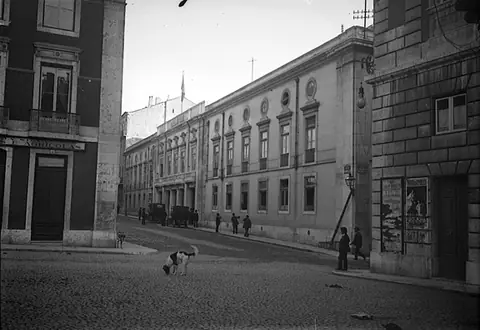
O Governo Civil de Lisboa, na Rua Capelo, entre 1905 e cerca de 1915. Fotografia de Charles Chusseau-Flaviens. Charles Chusseau-Flaviens, Public domain Before the political police headquarters was fully up and running, in 1938, it was the PSP police stations that held prisoners kept incommunicado — “the real logistics of repression”, in the words of the Memória Comum project. The 1st Station was here, in the Lisbon Civil Government building. Its cells took in prisoners on the eve of their trials before the Special Military Court, which were often held in the building itself.9
Helena Cabeçadas tells the Aljube Museum about the student association movement in the secondary schools (liceus), the academic crisis of 1962, which she lived through at 14, and her arrest in 1965, when she was taken to the Civil Government building and to Caxias. Expelled from every school in the country, she left alone for exile in Belgium at 17.
Original page Licença padrão do YouTube — embed permitido pelo canal oficial do Museu do Aljube
Museu do Aljube Resistência e Liberdade, on YouTube. The player only connects to that site when you press “Watch”.
To stop 4390 m · 5 min on footDirections
Stop 4: The political police headquarters
Rua António Maria Cardoso, 22, Lisboa (código postal do troço: 1249-101, segundo o OpenStreetMap)
Today: Residential apartment complex
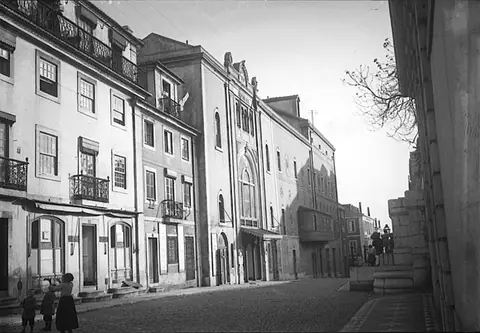
A Rua António Maria Cardoso, com o então Teatro da República (hoje São Luiz), entre cerca de 1911 e 1915. Fotografia de Charles Chusseau-Flaviens. Charles Chusseau-Flaviens, Public domain At No. 22 on this street stood the headquarters of the PVDE, later the PIDE and finally the DGS: the files, the informers, the interrogations.10 Interrogations took place on the third floor — beatings, sleep deprivation and the “estátua” (statue) torture, with squads of agents working in relays; against women, stripping and offences of a sexual nature were added.11
The factory worker Conceição Matos was brought here in April 1965, beaten for days and stripped in the interrogation room. “Anyone who looks at that case file knows I never talked to the police,” she said years later.12
What you can see today
A plaque put up by citizens in 1980 reads: “Here, on the afternoon of 25 April 1974, the PIDE opened fire on the people of Lisbon and killed: Fernando C. Gesteira, José J. Barneto, Fernando Barreiros dos Reis, José Guilherme R. Arruda. Tribute from a group of citizens – 25-4-1980”.18 Removed during the building works for the apartment complex, it was put back in 2009 in an inconspicuous corner. Lisbon City Council put up a plaque in 2010 and, in April 2024, a new one, with a code that leads to the biographies of the four dead on the Aljube Museum website.19
- 21 Apr 1965Arrest and torture of Conceição Matos
- 25 Apr 1974Disparos da PIDE/DGS matam quatro pessoas na Rua António Maria Cardoso
Conceição Matos and Domingos Abrantes tell together, in a testimony recorded by the museum on 7 October 2015, of life underground, imprisonment and torture. The museum’s keywords include the Aljube prison, Caxias, the PIDE interrogations and the escape from Caxias.
Original page Licença padrão do YouTube — embed permitido pelo canal oficial do Museu do Aljube
Museu do Aljube Resistência e Liberdade, on YouTube. The player only connects to that site when you press “Watch”.
To stop 5360 m · 5 min on footDirections
Stop 5: The “blue pencil”
Rua da Misericórdia, 125, 1.º, Lisboa (entrega de provas pelas traseiras: Rua das Gáveas, 90, 3.º)
Today: A building on Rua da Misericórdia
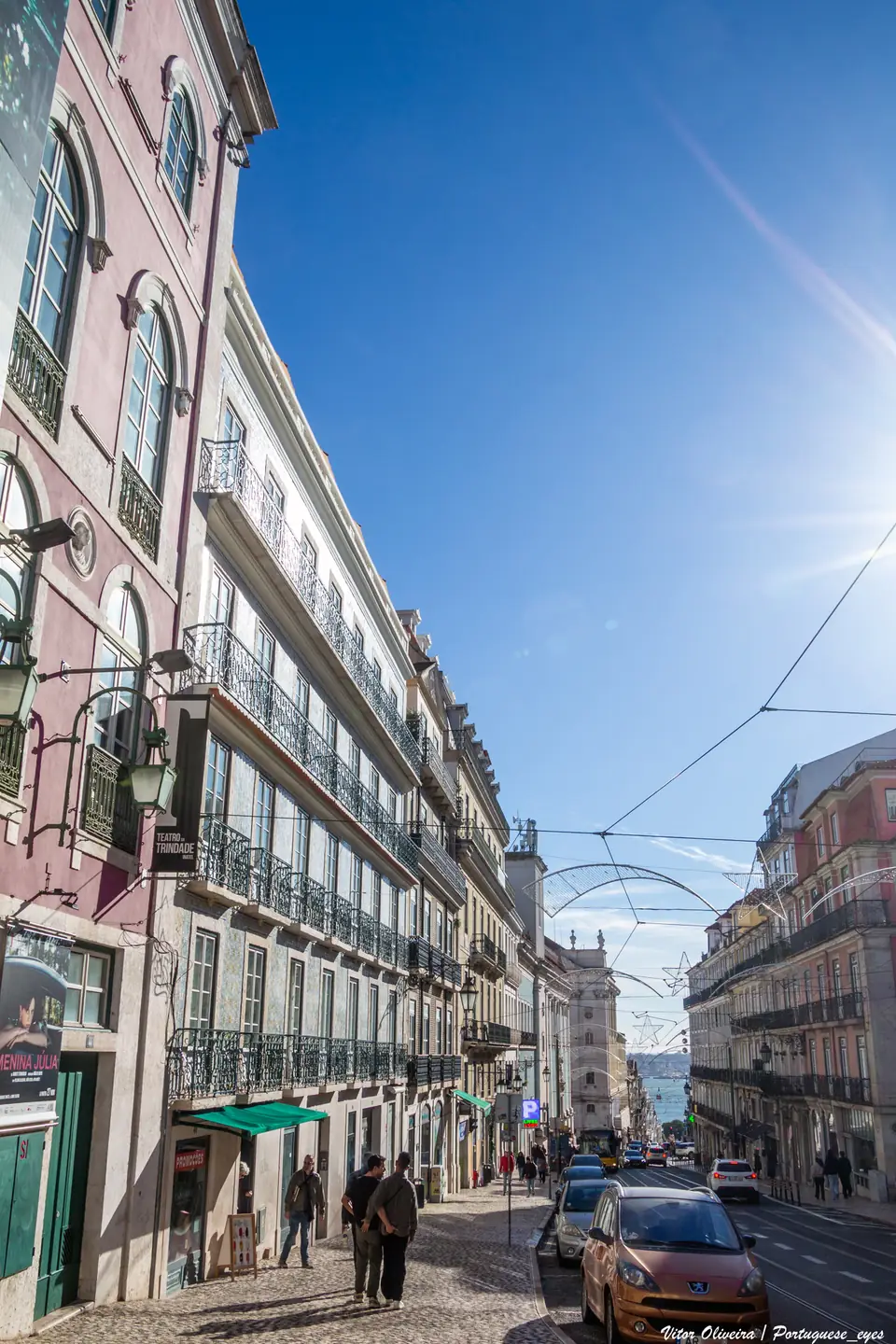
A Rua da Misericórdia, entre o Chiado e o Bairro Alto, em novembro de 2025. Vitor Oliveira, CC BY-SA 4.0 From 22 September 1969, press censorship worked from the first floor of No. 125 Rua da Misericórdia — the seventh address of a service that had been born in 1926 in the Carmo Barracks and never strayed far from the newsrooms. Newspapers sent in their page proofs and got them back stamped, cut with the “blue pencil”.13
Many texts by women did not get past this sieve: Diana Andringa had an article on the war in Angola cut, and Novas Cartas Portuguesas was withdrawn from circulation shortly after it came out.14 Almost opposite, at No. 116, was the newspaper República. On the morning of 25 April 1974 its editor, Raul Rego, refused to send the proofs to the “Prior Examination”, and the paper came out with a line at the foot of the front page: “This newspaper has not been vetted by any Censorship Commission” (Este jornal não foi visado por qualquer Comissão de Censura).15
To stop 6570 m · 10 min on footDirections
Stop 6: The propaganda palace
Praça dos Restauradores, 25, Lisboa (fachada posterior na Calçada da Glória)
Today: Palácio Foz: public services and the National Sports Museum
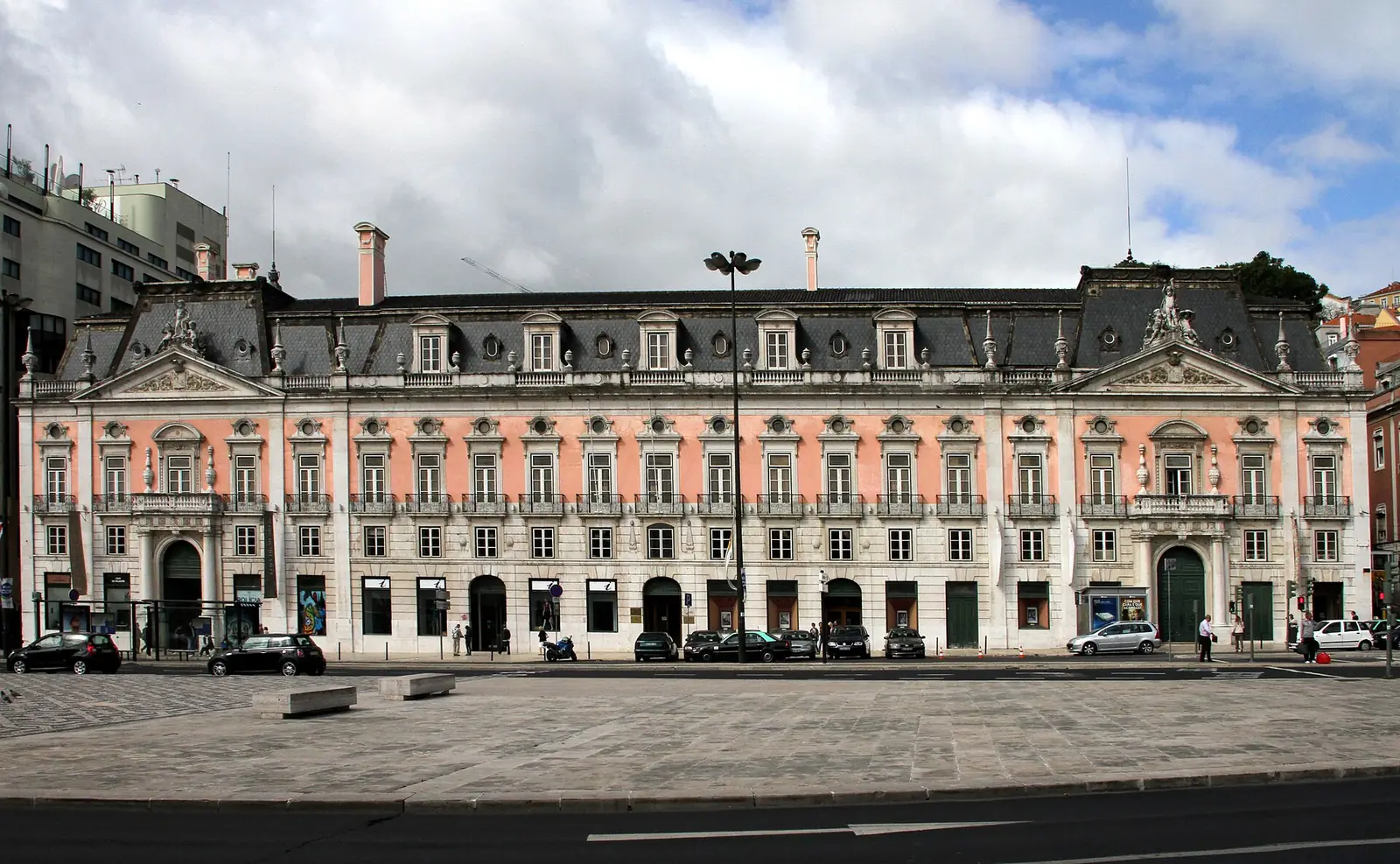
O Palácio Foz, na Praça dos Restauradores, em 2011. Gerd Eichmann, CC BY-SA 4.0 In 1933 the regime created the National Propaganda Secretariat, headed by the journalist António Ferro; in 1940 the State bought this palace to serve as its headquarters.16 Censorship passed through here too: between 1947/48 and 1961 it worked in the building, with its entrance on Calçada da Glória.13
And it was right next door, by the Elevador da Glória, that PIDE agents killed the worker David Almeida Reis, during the May Day demonstration on 1 May 1964.17


.JPG)

.jpg)
.jpg)
.jpg)
.jpg)
Notes on the sources2
- The exact street number of the Civil Government building on Rua Capelo, and the building’s current use; the stop is placed on that stretch of the street.
- The date on which the Lisbon Plenary Court began to sit at the Boa-Hora.
Do you know more, or do you have a document? Tell us.
Sources
- 1Os «crimes políticos» no Estado Novo (Prisões da Ditadura). Comissão Comemorativa 50 Anos 25 de Abril — consulted on 2 October 2026
- 2Cadeia do Aljube. Comissão Comemorativa 50 Anos 25 de Abril — consulted on 2 October 2026
- 3Cárceres do império. Memória Comum – Memorial aos Presos e Perseguidos Políticos — consulted on 2 October 2026
- 4Exposição de longa duração. Museu do Aljube Resistência e Liberdade (EGEAC) — consulted on 2 October 2026
- 5Manifesto quer devolver Tribunal da Boa Hora à cidade de Lisboa, agora como Museu Judicial (Ana da Cunha e Inês Leote, 4/3/2022). Mensagem de Lisboa — consulted on 2 October 2026
- 6Maria Alda Barbosa Nogueira. Memória Comum – Memorial aos Presos e Perseguidos Políticos — consulted on 2 October 2026
- 7Isabel Aboim Inglez. Museu do Aljube Resistência e Liberdade (EGEAC) — consulted on 2 October 2026
- 8«As Três Marias foram absolvidas» / «Absolvição para as Novas Cartas Portuguesas» (Diário de Lisboa, 8 de maio de 1974). Hemeroteca Municipal de Lisboa – Livros que foram notícia — consulted on 2 October 2026
- 930 Esquadras de Lisboa. Memória Comum – Memorial aos Presos e Perseguidos Políticos — consulted on 2 October 2026
- 10A sede e as delegações da PIDE. Comissão Comemorativa 50 Anos 25 de Abril — consulted on 2 October 2026
- 11Métodos de tortura. Memória Comum – Memorial aos Presos e Perseguidos Políticos — consulted on 2 October 2026
- 12Maria da Conceição Rodrigues de Matos. Memória Comum – Memorial aos Presos e Perseguidos Políticos — consulted on 2 October 2026
- 13Os censores da imprensa (Joaquim Cardoso Gomes), JJ – Jornalismo & Jornalistas n.º 57, jan./jun. 2014. Clube de Jornalistas (PDF no Centro de Documentação 25 de Abril, Univ. Coimbra) — consulted on 2 October 2026
- 14Diana Andringa (testemunho e biografia). Museu do Aljube Resistência e Liberdade — consulted on 2 October 2026
- 15O jornal República e a Rua da Misericórdia. Toponímia de Lisboa, 2019 — consulted on 2 October 2026
- 16Palácio Foz. Wikipédia (ponto de partida) — consulted on 2 October 2026
- 17Os que ficaram pelo caminho (lista, páginas 1 a 7). Memória Comum – Memorial aos Presos e Perseguidos Políticos — consulted on 2 October 2026
- 18Placa da ex-sede da PIDE: reposta mas em local escondido. Esquerda.net (29/12/2009) — consulted on 2 October 2026
- 19Esta semana, e sempre, a rua lembra os quatro homens assassinados pela PIDE/DGS. Time Out Lisboa (1/4/2024) — consulted on 2 October 2026
Other walks

Revolution · on foot
The first day
25 April 1974 hour by hour, from the Terreiro do Paço to the Carmo and the door of the political police
- Distance
- 2.4 km
- Duration
- 1 h 30 min
- Stops
- 7 stops
- Difficulty
- Moderate

Women · on foot
Graça, the women’s hill
Seamstresses on strike, a republican propagandist, a women’s prison, a bar and a poet — Graça as they tell it
- Distance
- 1.7 km
- Duration
- 1 h 15 min
- Stops
- 6 stops
- Difficulty
- Demanding

Repression · on foot
The Estado Novo, explained
How a dictatorship lasted 48 years: the leader, the façade, the single party, the family, work and propaganda — from São Bento to Restauradores
- Distance
- 4.6 km
- Duration
- 2 h 20 min
- Stops
- 9 stops
- Difficulty
- Moderate