Misericórdia
PVDE / PIDE / DGS headquarters
In the Chiado, the headquarters of the political police: the archives, the informers and, on the third floor, interrogation and torture. On 25 April, agents fired from here on the crowd and killed four people.
No. 22 Rua António Maria Cardoso, in the Chiado, was a building belonging to the House of Bragança. This was the headquarters of the political police — the PVDE, then the PIDE, finally the DGS: the administrative services, the archives and card indexes, the Information Services, which dealt with the informers, and the Investigation Services, which interrogated the prisoners.1 According to the Memória Comum project, the headquarters only became fully operational in 1938; until then, many prisoners were held incommunicado in PSP police stations.3
Interrogations took place on the third floor. Memória Comum describes the methods: beatings, sleep torture and the “statue” torture — the prisoner kept standing for days on end — applied by squads of agents who took turns every four hours; electric shocks, threats to the family, the lie that comrades had already talked. Women were also subjected to stripping, touching and offences of a sexual nature.56
The factory worker Conceição Matos was brought here on 21 April 1965: beaten for days, stripped, forced to soil herself in the interrogation room and to clean the floor with her own clothes. “Anyone who looks at that case file knows I never talked to the police,” she said years later.8 In 2005, at the door of the building, Maria José Morgado — arrested in October 1973 — recalled the slaps and the humiliations on the interrogation floor.9
People died here too. The worker Raul Alves fell from the third floor in 1958, in full view of several witnesses — among them the wife of the Brazilian ambassador, whose residence overlooked the back of the building.7 In 1964, the Interior Minister himself thought it better to move the interrogations to the South Redoubt of Caxias, partly because of the bad impression made by prisoners being shuttled back and forth through the streets of the city centre.1
On 25 April 1974, taking the headquarters was not part of the Armed Forces Movement’s plan, and throughout the day the crowd gathered at the door, demanding that the police surrender. Early in the evening, after Marcelo Caetano had already surrendered at the Carmo, DGS agents fired from the windows: Fernando Carvalho Giesteira, aged 18, José James Harteley Barneto, 38, João Guilherme Rego Arruda, 20, and Fernando Luís Barreiros dos Reis, 23, were killed. Dozens were wounded. It was never established who fired.252
Surrounded by cavalry and, before dawn, by marines, the DGS surrendered on the morning of 26 April. Its director, Silva Pais, declared his allegiance to the Movement — and took down from the wall, with his own hands, one of the portraits of the regime’s leaders.20
The building was sold and turned into a luxury apartment complex, whose advertising left out what had happened there.10 It was against this erasure that the Não Apaguem a Memória (Do Not Erase Memory) movement was born, in 2005.
On the walks
From the archives
In other archives
These can only be viewed on each archive’s own website.
- RTP Arquivos · Video · broadcast on 26 April 1974 · 2 minPrisão de Agentes da PIDE-DGSThe PIDE/DGS headquarters on Rua António Maria Cardoso, surrounded by soldiers and members of the public. Two agents caught trying to escape are taken by the soldiers to the Carmo Barracks; the item has no sound.Open in the archive
- RTP Arquivos · Video · broadcast on 3 May 1974 · 23 minVisita às instalações da PIDE/DGS em LisboaPortuguese and foreign journalists, with João Bénard da Costa, enter the headquarters of the now-abolished PIDE/DGS on Rua António Maria Cardoso. They see wrecked rooms, files on citizens, the post that recorded phone calls, and a soldier taking Salazar’s portrait down from the wall.Open in the archive
- RTP Arquivos · Video · broadcast on 31 August 1992 · 31 minEm Nome dos Amanhãs que Cantam – Parte IA programme by Diana Andringa on the political prisoners of the Estado Novo (“New State”), with footage of the Aljube, the PIDE headquarters, Caxias, Peniche and Tarrafal. Former prisoners describe their imprisonment, a former PIDE/DGS inspector justifies the police, and Fernando Rosas and Luandino Vieira speak.Open in the archive
Where it is
Map showing where PVDE / PIDE / DGS headquarters is.
Dates
1938
The headquarters becomes fully operational (according to Memória Comum).
1958
Death of the worker Raul Alves, who fell from the third floor.
21 April 1965
Conceição Matos is brought to the headquarters and tortured.
25 April 1974
DGS agents fire on the crowd: four dead and dozens wounded.
26 April 1974
The DGS surrenders in the morning.
25 April 1980
A group of citizens puts up a plaque with the names of the four dead.
5 October 2005
The Não Apaguem a Memória (Do Not Erase Memory) movement is born.
3 April 2024
Lisbon City Council unveils a new plaque, with a code linking to the victims’ biographies.
29 Aug 1933
The State Surveillance and Defence Police (PVDE) is created22 Oct 1945
The political police becomes the PIDE31 Jul 1958
Raul Alves falls from the third floor of the PIDE headquarters27 Apr 1962
Arrest of the Women of CouçoOct 1973
Arrest and torture of Maria José Morgado25 Apr 2010
Placa municipal sinaliza a antiga sede da PIDE/DGS
People connected with this place
- Conceição Matos b. 1936Interrogated and tortured at the PIDE headquarters after her arrest (21 April 1965)
- Fernando Giesteira 1955–1974Killed by DGS gunfire (25 April 1974)
- Fernando Reis 1950–1974Killed by DGS gunfire (25 April 1974)
- Helena Pato b. 1939Her husband was taken to the headquarters on his return to Portugal; in 2010 she spoke at the unveiling of the municipal plaque (November 1965)
- João Arruda 1954–1974Fatally hit by DGS gunfire (25 April 1974)
- José Barneto 1935–1974Killed by DGS gunfire (25 April 1974)
- Maria José Morgado b. 1951Interrogated, slapped and humiliated at the headquarters; in 2005 she gave her testimony at the door of the building (October 1973)
- Raul Alves 1914–1958Killed falling from the 3rd floor of the headquarters (31 July 1958)
- Silva Pais 1905–1981Surrendered the DGS headquarters (26 April 1974)
Nearby
160 m · 5 min on foot
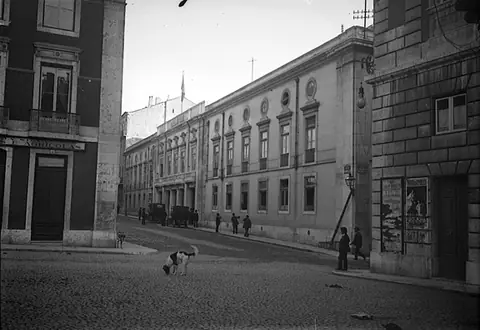
Lisbon Civil Government and the PSP’s 1st Station
Today: The building of the former Civil Government
Seat of the Lisbon Civil Government, in a former building of the Convent of São Francisco. The PSP’s 1st Station, housed there, had cells where the political police locked up many prisoners, especially before 1938, and where trials of the Special Military Court were held.
Repression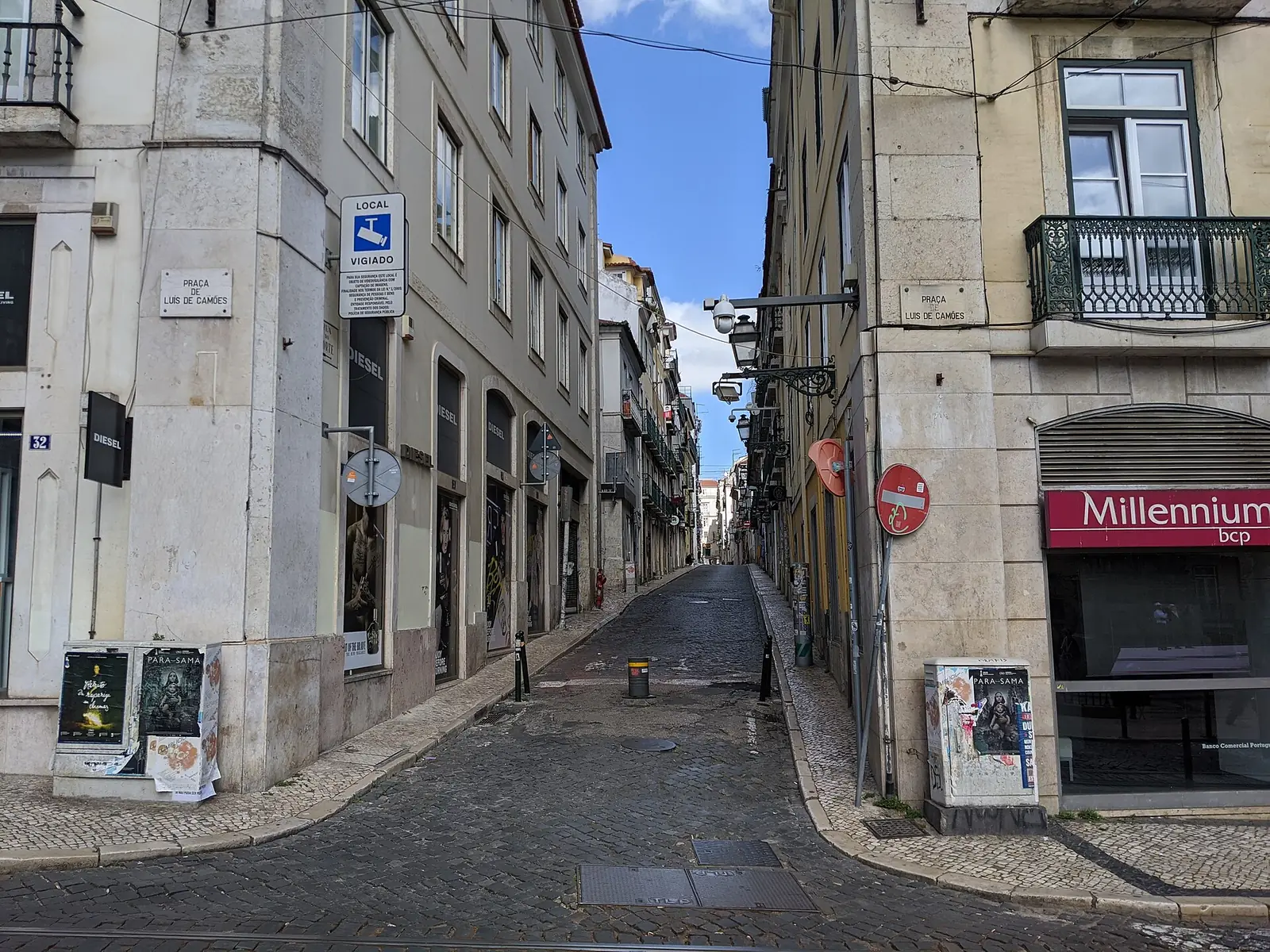
170 m · 5 min on foot
Editorial offices of the newspaper “A Capital” (Rua do Norte, 3)
At no. 3 Rua do Norte, on the corner with Praça de Luís de Camões, were the editorial offices of “A Capital”, a republican evening daily. Virgínia Quaresma, the first woman journalist in Portugal, wrote for it and lived just opposite; in 1911, the paper told the story of Carolina Beatriz Ângelo’s fight for the vote.
WomenRepublicCulture and censorship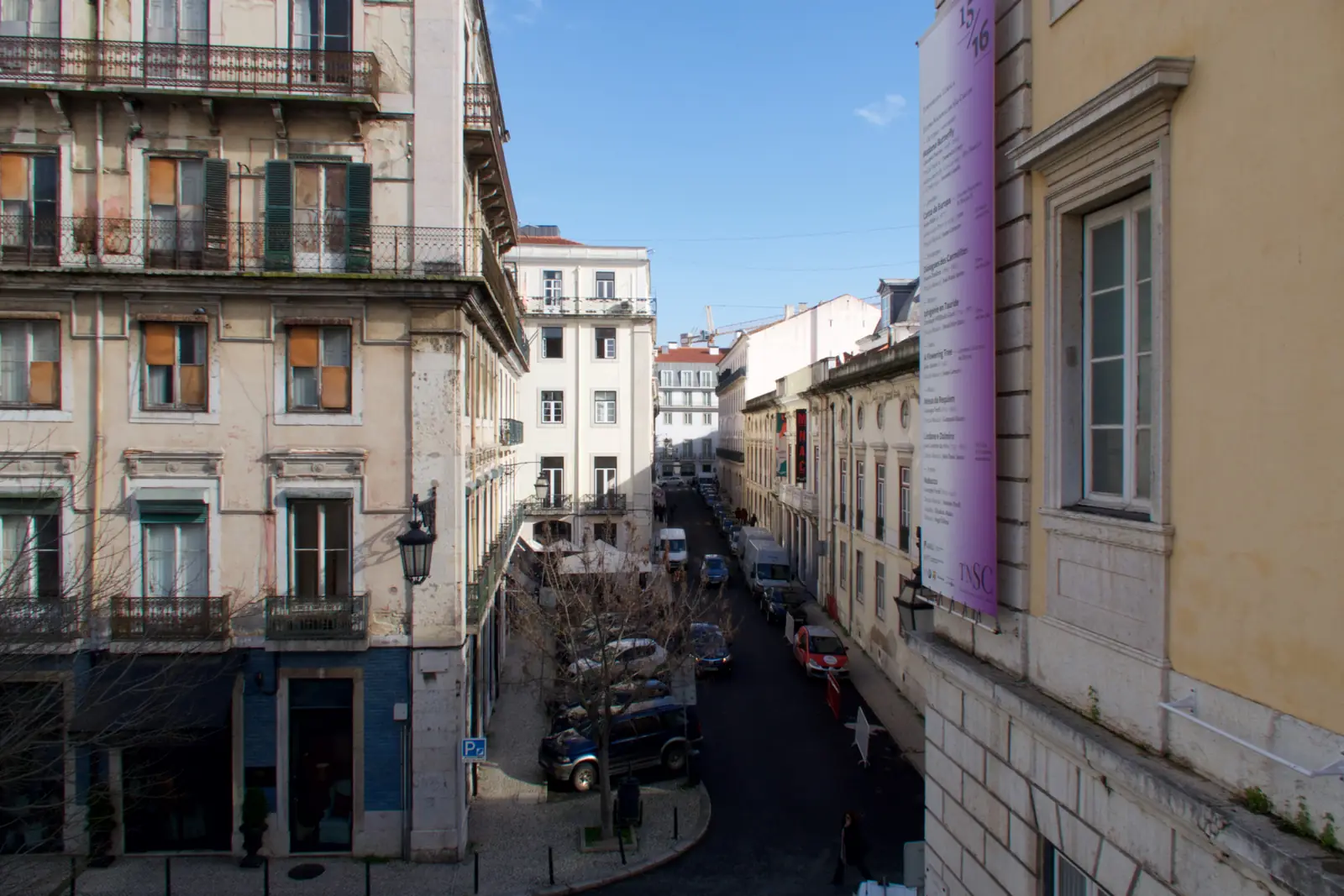
190 m · 5 min on foot
Rádio Renascença (the Rua Capelo studios)
Today: A hotel, The Ivens
In the Rádio Renascença studios, on the second floor of no. 5 Rua Capelo, the first verse of “Grândola, Vila Morena”, by José Afonso, went on air at 00:20 on 25 April 1974, on the programme “Limite” — the signal that confirmed the advance of the MFA troops.
RevolutionCulture and censorship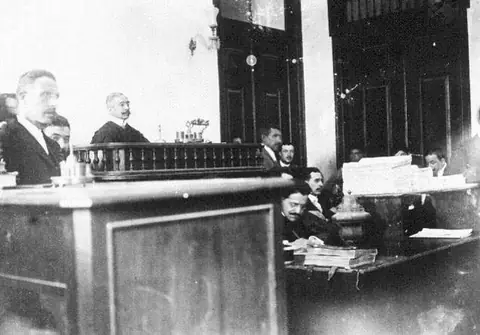
270 m · 5 min on foot
Boa-Hora Court
Today: Former court, closed since 2009
A convent turned into a court in 1843. The Plenary Court, which tried political prisoners, sat here — and it was here that Maria Alda Nogueira, Natália Correia and the “Three Marias” were tried; the Three Marias were acquitted after 25 April.
RepressionWomenCulture and censorship


.jpg)
Notes on the sources16
- The time of the shooting on 25 April: “at around 20:15” (25 April Association), “close to 20:30” (Aljube Museum), 21:00 (chronology of the Portuguese Commission of Military History); the 1980 plaque says “in the afternoon”. The surrender on 26 April: at around 09:00 or 09:30.
- Coordinates: no. 22 is not geocoded in OpenStreetMap; I used the point for the stretch of street returned by Nominatim.
- The current commercial name of the apartment complex: Esquerda.net (2009) mentions the “Paço do Duque website”; I have not confirmed whether the name is still in use in 2026.
- The chronology of the Portuguese Commission of Military History (CPHM) also records that a DGS man captured in the street was shot dead while trying to escape; I found no confirmation in any other source.
- Raul Alves: the 50 Years Commission dates his death to 1 August 1957; Memória Comum gives 31 July 1958, in the context of the strike at the Companhia Industrial Portuguesa after the elections of 8 June 1958. I chose 1958 because the context fits.
- António Lopes Almeida (1949): the 50 Years Commission places his death in a room on the third floor of the headquarters; Memória Comum says he died in Aljube Prison, on 21 January 1949.
- The exact wording of the 2010 municipal plaque, and confirmation that the plaque with the QR code announced for 3 April 2024 was put up.
- Spelling on the plaques: “Gesteira” and “José Guilherme R. Arruda” (1980 plaque) vs “Giesteira” and “João Guilherme Rego Arruda” (Aljube Museum).
- The date on which the PIDE was renamed the DGS (1969) has not been confirmed in any source consulted.
- The interrogation floor: “third floor” (50 Years Commission; Memória Comum) vs “fourth floor” in Maria José Morgado’s account to “Jornal de Notícias” (2005) — perhaps a difference in how the floors are counted.
- Earlier shooting: Jofre Alves (CD25A, the 25 April Documentation Centre) mentions bursts of fire at 13:30 with five wounded, and one death at 16:15 — not confirmed in other sources.
- Street number: 22 (25 April Association, Time Out) or 20 (Observador).
- The exact wording and current location of the 1980 and 2010 plaques.
- To check on site whether the memorial stone is still in the same place.
- The names of Conceição Matos’s interrogators: only in Wikipedia.
- The five “Mulheres do Couço” (Women of Couço), arrested in April 1962, are said to have been interrogated and tortured at this headquarters — only Wikipedia says so, among the sources consulted.
Do you know more, or do you have a document? Tell us.
Sources
- 1A sede e as delegações da PIDE. Comissão Comemorativa 50 Anos 25 de Abril — consulted on 2 October 2026
- 2Sede da Pide/DGS (Locais de Abril). Associação 25 de Abril — consulted on 2 October 2026
- 3Cárceres do império. Memória Comum – Memorial aos Presos e Perseguidos Políticos — consulted on 2 October 2026
- 47. Isolamento e «celas disciplinares». Memória Comum – Memorial aos Presos e Perseguidos Políticos — consulted on 2 October 2026
- 5Métodos de tortura. Memória Comum – Memorial aos Presos e Perseguidos Políticos — consulted on 2 October 2026
- 6A tortura como sistema. Memória Comum – Memorial aos Presos e Perseguidos Políticos — consulted on 2 October 2026
- 7Raul Alves. Memória Comum – Memorial aos Presos e Perseguidos Políticos — consulted on 2 October 2026
- 8Maria da Conceição Rodrigues de Matos. Memória Comum – Memorial aos Presos e Perseguidos Políticos — consulted on 2 October 2026
- 9À soleira da porta da Pide. Jornal de Notícias (13/3/2005) — consulted on 2 October 2026
- 10Sede da PIDE transformada em condomínio de luxo. Correio da Manhã — consulted on 2 October 2026
- 11Placa da ex-sede da PIDE: reposta mas em local escondido. Esquerda.net (29/12/2009) — consulted on 2 October 2026
- 12Inauguração da placa sinalizadora junto à antiga sede da PIDE/DGS. Caminhos da Memória (blogue ligado ao movimento Não Apaguem a Memória, 27/4/2010) — consulted on 2 October 2026
- 13Esta semana, e sempre, a rua lembra os quatro homens assassinados pela PIDE/DGS. Time Out Lisboa (1/4/2024) — consulted on 2 October 2026
- 14Fernando Carvalho Giesteira (biografia). Museu do Aljube Resistência e Liberdade — consulted on 2 October 2026
- 15José James Harteley Barneto (biografia). Museu do Aljube Resistência e Liberdade — consulted on 2 October 2026
- 16João Guilherme Rego Arruda (biografia). Museu do Aljube Resistência e Liberdade — consulted on 2 October 2026
- 17Fernando Luís Barreiros dos Reis (biografia). Museu do Aljube Resistência e Liberdade — consulted on 2 October 2026
- 18O golpe militar de 25 de Abril de 1974. Uma cronologia (Abílio Pires Lousada e Humberto Nuno de Oliveira), Revista Portuguesa de História Militar, IV, n.º 6. Comissão Portuguesa de História Militar / Ministério da Defesa (jun. 2024) — consulted on 2 October 2026
- 19Nominatim – OpenStreetMap (geocodificação). OpenStreetMap contributors (ODbL) — consulted on 2 October 2026
- 20Movimentações do dia 25 de Abril. Associação 25 de Abril — consulted on 2 October 2026
- 21Operação Viragem Histórica. Comissão Comemorativa 50 Anos 25 de Abril — consulted on 2 October 2026
- 22O 25 de Abril para os mais novos – Cronologia hora a hora. Centro de Documentação 25 de Abril – Universidade de Coimbra — consulted on 2 October 2026
- 23Cronologia do 25 de Abril, por Jofre Alves (blogue Abril de Novo, 2010), na Biblioteca Digital do CD25A. Centro de Documentação 25 de Abril – Universidade de Coimbra — consulted on 2 October 2026
- 24Os mortos pela PIDE em 25 de Abril. Esquerda.net — consulted on 2 October 2026
- 2525 de Abril de 1974. Museu do Aljube Resistência e Liberdade (EGEAC) — consulted on 2 October 2026
- 26Mónicas (testemunho de Magda Fonseca). URAP – União de Resistentes Antifascistas Portugueses — consulted on 2 October 2026
- 27Conceição Matos. Wikipédia (português) — consulted on 2 October 2026
- 28Mulheres do Couço. Wikipédia (português) — consulted on 2 October 2026
Coordinates: OpenStreetMap (Nominatim), consultado a 2 de outubro de 2026.