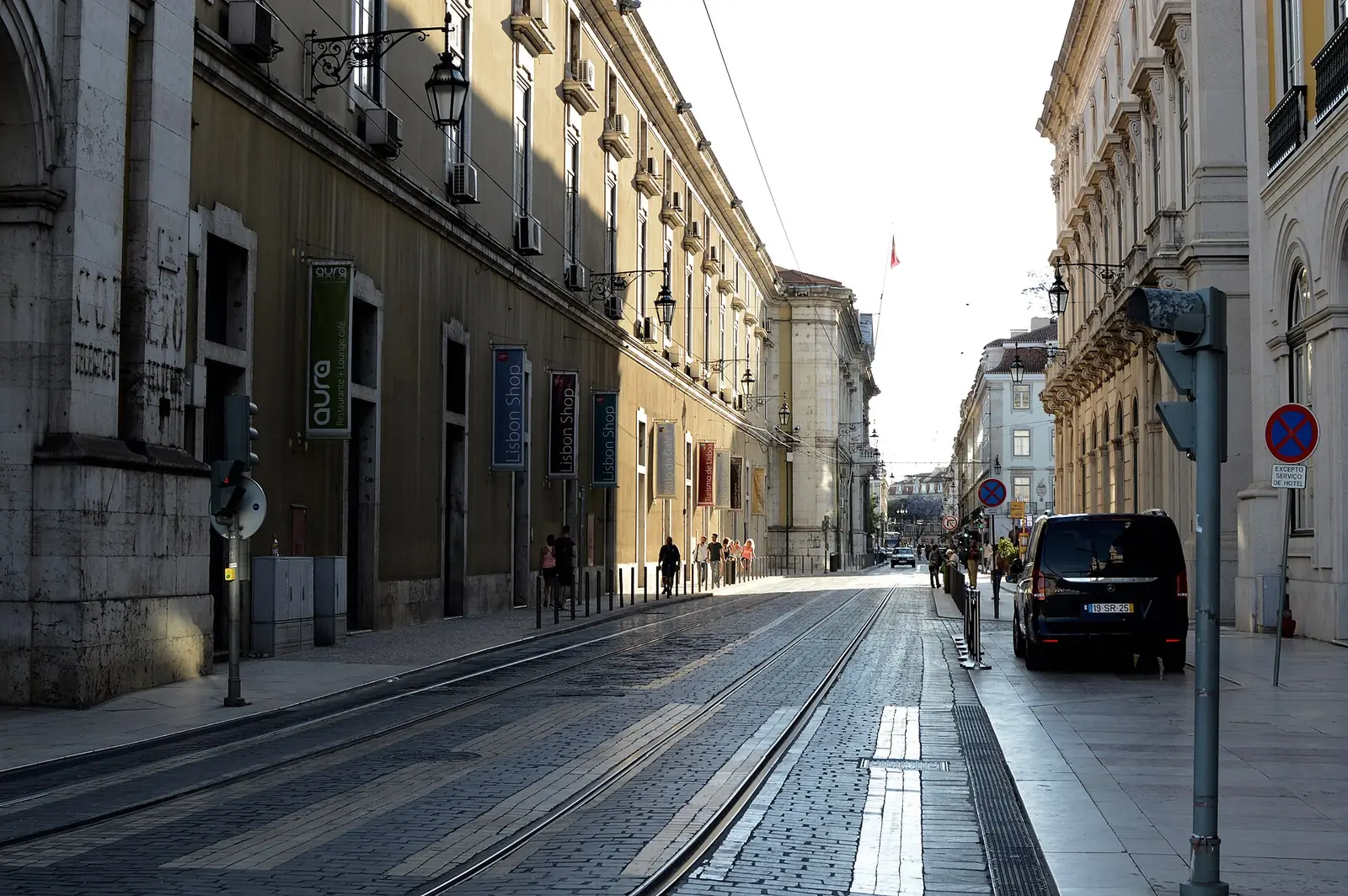
The square of the ministries, the centre of power of the Estado Novo (“New State”). At dawn on 25 April 1974 Captain Salgueiro Maia’s column from Santarém occupied it; the forces sent against it went over one after another to the Movement’s side, and the ministers escaped through a wall knocked open with pickaxes.
Today: Praça do ComércioThere is a marker at the siteApproximate locationOn one walk
Under the dictatorship, the square of the ministries was also a place of protest. In May 1958, on Humberto Delgado’s return to Lisbon after his day in Porto, a crowd waited for the general all the way from Santa Apolónia to here; the PIDE diverted his motorcade and the GNR chased and beat his supporters across the Terreiro do Paço, the Rossio and the Restauradores.8 On May Day (1 May) 1962, at the height of the academic crisis, workers and students demonstrated in the Baixa and there were clashes in the Terreiro do Paço, the Carmo, the Rossio, Martim Moniz and Alcântara.9
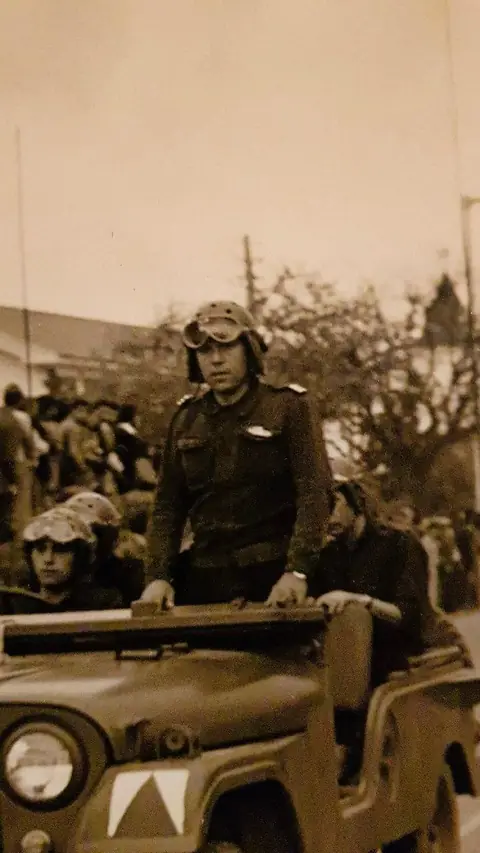
On 25 April 1974, this square was the main centre of the regime’s political power. The Armed Forces Movement included it among the objectives to be occupied because it was a symbol of the power to be overthrown and because the Army and Navy ministries were here, from which the regime could interfere in the operations.1 The column from the Cavalry Practical School had left Santarém at 03:30 — ten armoured vehicles, twelve transport vehicles, two ambulances and a jeep — with the mission of controlling access to the Bank of Portugal, Rádio Marconi and the Terreiro do Paço.4 There were about 220 soldiers, commanded by Captain Salgueiro Maia, Captain Mário Tavares de Almeida and Lieutenants Alfredo Assunção and Rui Santos Silva.1 At around 06:00, Maia reported to the Command Post: “I report that we have occupied Toledo and that we control Brussels and Vienna” (Informo que ocupamos Toledo e que controlamos Bruxelas e Viena) — the Terreiro do Paço, the Bank of Portugal and Rádio Marconi.5
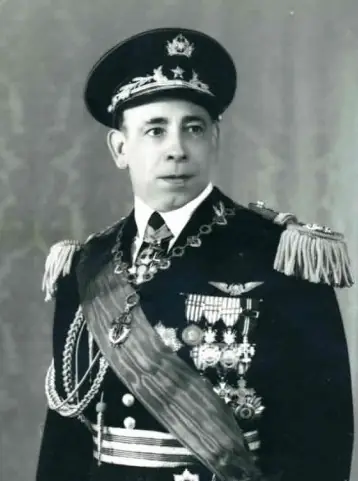
The PSP surrounding the area did not interfere and helped to keep civilians away.4 The forces sent by the regime went over one after another to the Movement’s side: the 7th Cavalry Regiment’s platoon of Chaimite armoured cars under conscript Second Lieutenant David e Silva, the two Military Police platoons guarding the Army Ministry and, later, the Panhard armoured car force of Lieutenant Colonel Ferrand de Almeida, who could not get his men to obey him and was arrested and disarmed by Maia.56
From the windows of the Army Ministry the occupied square could be seen. At around 08:30, the minister, General Andrade e Silva, had a brick wall that led into the library of the Navy Ministry knocked through with pickaxes. Before 10:00 the Ministers of Defence, of Information and Tourism and of the Navy, the Chief of the General Staff of the Armed Forces, the military governor of Lisbon and Admiral Henrique Tenreiro, among others, escaped that way; the command post of the forces loyal to the regime was set up at the Lanceiros 2 Regiment, on Calçada da Ajuda.5
On the river, at 07:30, the frigate Almirante Gago Coutinho was ordered to take up position opposite the Terreiro do Paço and, later, to open fire on the armoured vehicles. The order was not carried out.5 The MFA artillery positioned near the Cristo-Rei had orders to sink the frigate if it fired; at midday, the ship withdrew to the Mar da Palha.6 At 09:35 the force of Brigadier Junqueira dos Reis arrived along the Ribeira das Naus; there, Officer Cadet Fernando Sottomayor and the tank gunners refused to fire on Salgueiro Maia, who was advancing with a white handkerchief.5 Close to midday, with thousands of people in the Baixa, Maia left here with a column for Largo do Carmo.4
On 16 November 1975, four days after the siege of the Constituent Assembly at São Bento, the square filled with a demonstration against the government. In the Constituent Assembly, the communist deputy Octávio Pato called it “a milestone in the struggle for the democratic revolution”.7
On the Ribeira das Naus and Rua do Arsenal, on the morning of 25 April 1974, the soldiers of the forces loyal to the regime refused Brigadier Junqueira dos Reis’s orders to fire on Salgueiro Maia. “That was where 25 April was won” (Foi ali que se ganhou o 25 de Abril), Maia would say.
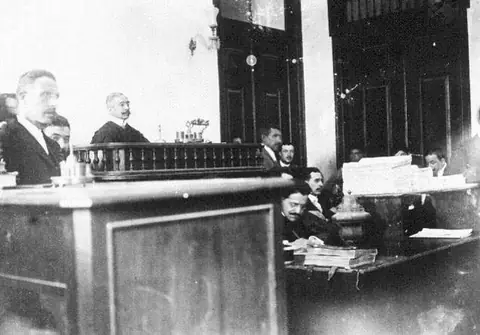
A convent turned into a court in 1843. The Plenary Court, which tried political prisoners, sat here — and it was here that Maria Alda Nogueira, Natália Correia and the “Three Marias” were tried; the Three Marias were acquitted after 25 April.
An advertisement from 1909 places the surgery of Carolina Beatriz Ângelo, a gynaecologist and the first Portuguese woman surgeon, here, at no. 84 Rua Nova do Almada — two years before she became the first woman to vote in Portugal.
In the Rádio Renascença studios, on the second floor of no. 5 Rua Capelo, the first verse of “Grândola, Vila Morena”, by José Afonso, went on air at 00:20 on 25 April 1974, on the programme “Limite” — the signal that confirmed the advance of the MFA troops.
RevolutionCulture and censorship
Notes on the sources3
The time of the occupation: 05:50 (Jofre Alves, CD25A), 06:00 (25 April Association, “Movimentações”, and the Commemorative Commission) or 06:10 (the message to the Command Post, in the “Places of April”).
Who stopped the frigate from firing: the 25 April Association attributes it to the executive officer, Lieutenant Fernando Caldeira dos Santos; Jofre Alves calls him Fernando Ferreira dos Santos; the Commemorative Commission speaks of the crew, which was “with the Movement”.
Where in the square the “Places of April” plaque is.
Do you know more, or do you have a document? Tell us.