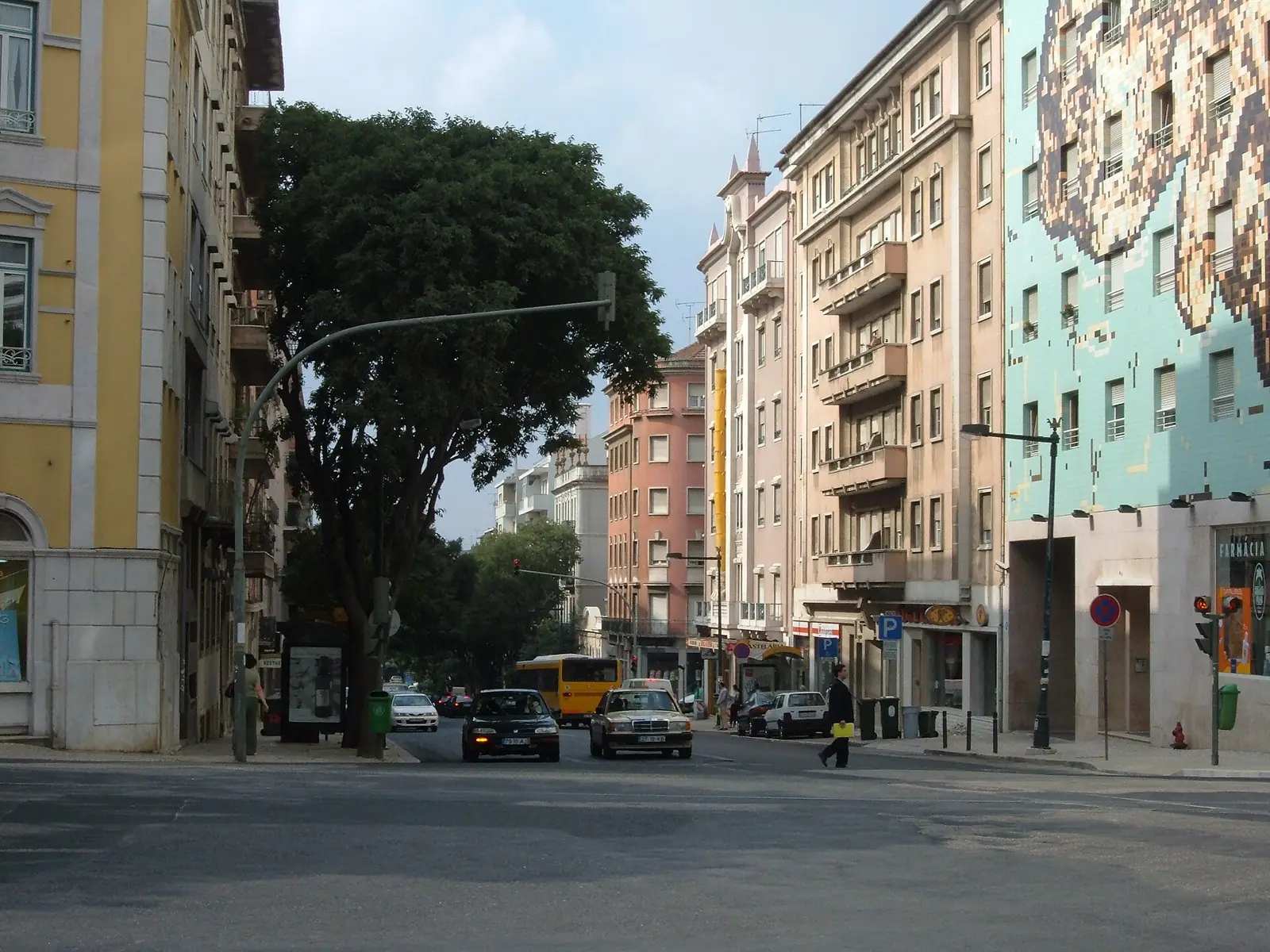
A Alameda D. Afonso Henriques vista do alto, com o Instituto Superior Técnico ao fundo, em agosto de 2025.Alexkom000, CC BY 4.0
Arroios
Instituto Superior Técnico
Pardal Monteiro’s campus was the scene of decisive plenary meetings of the student movement: here the academic mourning of 1962 was suspended, here the PIDE raided the students’ association in 1968, and here it was decided, in 1972, to go en masse to Ribeiro Santos’s funeral.
Today: Instituto Superior Técnico – University of LisbonOn one walk
The Alameda campus, designed by Porfírio Pardal Monteiro, was born under the aegis of Duarte Pacheco, on the Arco do Cego land, and was completed between 1936 and 1937.7 In 1953, Maria de Lourdes Pintasilgo graduated here in Industrial Chemical Engineering: of the 250 students on her course, only three were women.8
In the academic crisis of 1962, with the exam season looming, a plenary meeting at the Técnico voted by a majority, on 15 June, to suspend the academic mourning. Some students were unhappy, but the associations abided by the decision; the protest went on over the imprisonment of the student leaders, above all Eurico de Figueiredo, and over the disciplinary proceedings.1
Under the influence of May ’68 and with the growing rejection of the colonial war, student mobilisation grew again. On 8 December 1968, the PIDE raided the Técnico Students’ Association, seized documents and identified students. The association and the Institute were closed until the end of the holidays, the association’s board was suspended and several students faced disciplinary proceedings.3 There followed the police invasion of the Cidade Universitária, a form of intimidation that would become recurrent.2
On the night of 12 October 1972, hours after José António Ribeiro Santos had been shot dead by a PIDE/DGS agent at the ISCEF, 300 students meeting at the Técnico voted to bring the university to a standstill and to go to the funeral en masse.45 That year, the IST was again invaded by riot police and closed.3
On 15 May 1977, the Democratic Women’s Movement (MDM) held its 3rd National Meeting here, under the slogan “The Strength of being a Movement, the Reason for being Democratic and the Joy of being a Woman” (A Força de ser Movimento, a Razão de ser Democrático e a Alegria de ser Mulher). Two thousand women, in five working groups, approved the first Charter of Women’s Rights.9
The history of these struggles is told in the book O activismo estudantil no IST (1945-1980) (Student Activism at the IST, 1945–1980), edited by Luísa Tiago de Oliveira and presented at the Aljube Museum in November 2019.3
Created by the regime in 1944 to foster “imperial unity” among students from the colonies, it became a school of opposition and anti-colonialism: Amílcar Cabral, Agostinho Neto and Alda do Espírito Santo passed through here. The PIDE closed it in 1965.
In this republican centre on Calçada de Arroios, while the monarchy still ruled, Maria Veleda set up free evening courses to teach women to read and write; in 1907, the Portuguese Group for Feminist Studies gave classes here to illiterate women.
On 28 May 1911, the São Jorge de Arroios polling station was set up here. It was there that the doctor Carolina Beatriz Ângelo, registered by order of a judge, became the first woman to vote in Portugal.
In 1951 the Centre for African Studies was set up in the house where the São Toméan poet Alda do Espírito Santo lived: Amílcar Cabral, Mário Pinto de Andrade, Francisco José Tenreiro and others met here to “get to know Africa”, away from the eyes of the PIDE.
ColonialismWomenStudents
Notes on the sources2
The day of the plenary meeting that suspended the academic mourning of 1962: 15 June (Commemorative Commission) or 14 June (Wikipedia).
When, and for how long, the IST was closed in 1972.
Do you know more, or do you have a document? Tell us.