Repressionwritertranslatorjuror for the SPE’s Grand Prize for Fiction (1965)defence witness in the trial over “Novas Cartas Portuguesas” (New Portuguese Letters)
Born
1 December 1926, Porto
Died
11 December 2007, Lisbon
A novelist, she was the only woman on the jury of the Portuguese Society of Writers that gave a prize to “Luuanda”, by Luandino Vieira, in 1965 — the prize that led to the dissolution of the society and the imprisonment of three of the jurors.
She was born in Porto in 1926. She studied Classical Philology at the universities of Coimbra and Lisbon and settled in Lisbon. She was a co-founder of the magazine Távola Redonda, made her debut with Coordenadas Líricas (Lyrical Coordinates) in 1951, and received the Camilo Castelo Branco Prize in 1960.3
In May 1965 she was the only woman on the jury — with Alexandre Pinheiro Torres, Augusto Abelaira, João Gaspar Simões and Manuel da Fonseca — that gave the Grand Prize for Fiction of the Portuguese Society of Writers to Luuanda, by Luandino Vieira, who was then a prisoner at Tarrafal.12 The five jurors were questioned by the PIDE, and Pinheiro Torres, Abelaira and Manuel da Fonseca were imprisoned; the government dissolved the society, whose headquarters were raided and wrecked.1 Twenty-five years later, Fernanda Botelho told RTP that she had never expected the controversy, let alone the regime’s reaction, and that she had voted on literary, not political, grounds.2
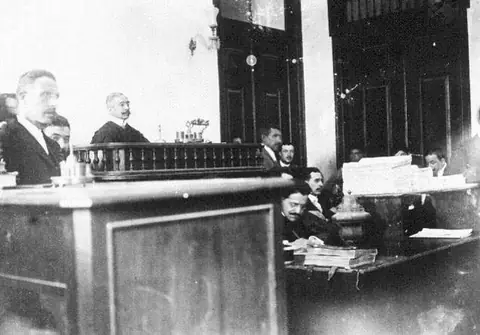
She was one of the defence witnesses for the authors of Novas Cartas Portuguesas (New Portuguese Letters), at the trial held at the Boa-Hora Court in 1973–1974.4 She died in Lisbon in 2007.3
A Portuguese-Angolan writer, the author of “Luuanda”. The prize that the Portuguese Society of Writers gave him in 1965, while he was imprisoned at Tarrafal, led the PIDE to question the jury and detain three of the jurors, and the regime to wreck the SPE’s headquarters and dissolve it.
A writer and researcher, one of the “Three Marias”. Tried over “Novas Cartas Portuguesas” (New Portuguese Letters) and acquitted on 7 May 1974, she saw the greatest consequence of the case in the Constitution: equality for all, “without distinction of race, sex or religion”.
A journalist and writer, she edited “Modas e Bordados” (Fashions and Embroidery), chaired the National Council of Portuguese Women until the regime closed it down in 1947, and responded with “As Mulheres do Meu País” (The Women of My Country). She was arrested several times and lived in exile in Paris.
A poet and journalist, one of the “Three Marias”. The PIDE seized her “Minha Senhora de Mim” (My Lady of Myself) and three men beat her up in the street; with Maria Isabel Barreno and Maria Velho da Costa she wrote “Novas Cartas Portuguesas” (New Portuguese Letters), which took them to court — and to acquittal, on 7 May 1974.
The novelist of “Maina Mendes” and “Casas Pardas”, she was the one who put to the other two Marias the question that gave rise to “Novas Cartas Portuguesas” (New Portuguese Letters). She received the Camões Prize in 2002.
A poet and publisher, she was the Portuguese writer with the most works censored. Tried at the Plenary Court over the “Antologia de Poesia Portuguesa Erótica e Satírica” (Anthology of Portuguese Erotic and Satirical Poetry), she published “Novas Cartas Portuguesas” (New Portuguese Letters) and opened the Botequim in Graça, where she celebrated 25 April. She later became a deputy.
Notes on the sources2
The day of birth (1 December 1926) and of death (11 December 2007) come only from Wikipedia and Wikidata.
At which session of the “Novas Cartas Portuguesas” trial she gave evidence: Wikipedia names her among the defence witnesses, without a date.
Do you know more, or do you have a document? Tell us.