A entrada da Penitenciária de Lisboa, hoje Estabelecimento Prisional de Lisboa, na Rua Marquês de Fronteira, em 2016.Chester, CC BY 2.0
Campolide
Lisbon Penitentiary
A prison for common crimes that the political police used for political prisoners, above all in prolonged isolation. The sailors of the 1936 revolt left from here for Tarrafal, and the communist leader Militão Ribeiro died here, on hunger strike, in 1950.
The Lisbon Penitentiary, in Campolide, was a prison for common crimes, but the political police also used it for political prisoners.3 Memória Comum points to “some cells of the Penitentiary”, alongside the “curros” (isolation cells) of the Aljube, as the prime example of the long periods of isolation that went hand in hand with torture, to cut prisoners off from the world and diminish them.1 Seen from above, the six-winged building looks like a star; it is the setting of the novel A Estrela de Seis Pontas (The Six-Pointed Star), which Álvaro Cunhal published under the pseudonym Manuel Tiago.9
After the sailors’ revolt of 8 September 1936, the prisoners were taken through the police post at the “Mitra” and, on 18 September, admitted to the Penitentiary; on 17 October they embarked for the newly created Tarrafal concentration camp.76 The Penitentiary was one of the prisons from which prisoners were sent to Tarrafal.8
Those who died here include Américo Gomes, an activist in the Communist Youth, on 16 March 1934, aged 22, after 14 months in captivity; the bargeman Aurélio Dias, an activist of the Portuguese Communist Party (PCP), on 30 October 1934, after being “violently tortured” — three days later, the Special Military Court reduced his sentence to two years in prison, “deemed served by the time already spent”; and Senen Vasquez Albela, arrested with his brothers after the Spanish Civil War and handed over here in 1941, who died in 1956, aged 38.4 The anarchist Emídio Santana, arrested after the 1937 attack on Salazar, also passed through the Penitentiary.12
The communist leader Militão Ribeiro was arrested on 25 March 1949 in a clandestine house in Luso, together with Álvaro Cunhal and Sofia Ferreira.11 On 10 May he was transferred to the Penitentiary. Ill, he spent nine months in strict isolation, without medical care worthy of the name; in letters written two months before he died, he accused the PIDE of “poisoning”. He went on hunger strike in protest against the prison regime and died in prison on 2 January 1950, aged 54.54
The building is now Lisbon Prison, classified as a monument of public interest; Wikipedia gave its closure as planned for 2026.9
In the early hours of 25 April 1974, MFA officers occupied these studios and made Rádio Clube Português the voice of the Movement: at 04:26, Joaquim Furtado read the first communiqué here. In the afternoon, it was a woman, Clarisse Guerra, who read another.
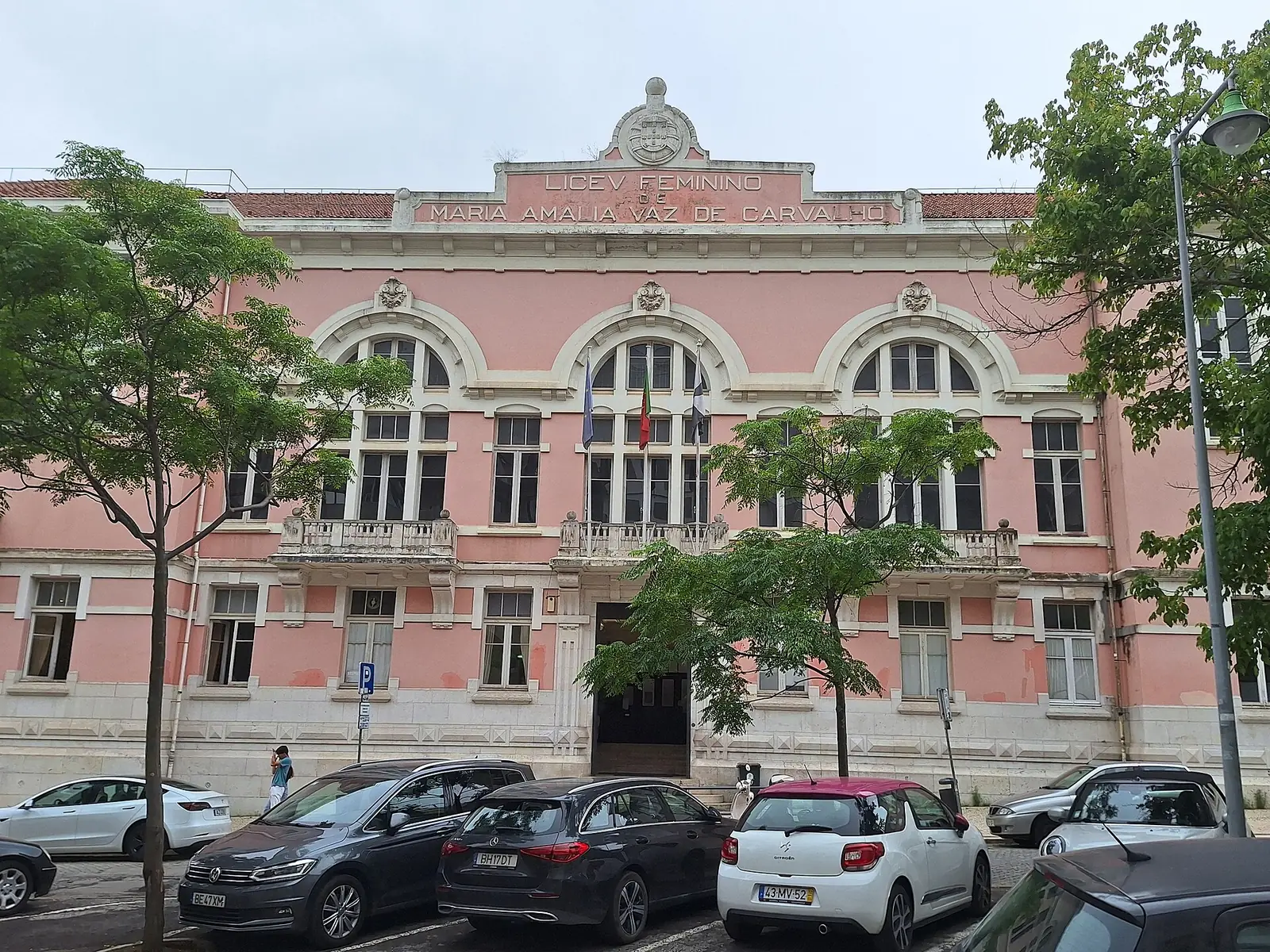
Today: Maria Amália Vaz de Carvalho Secondary School
The country’s first girls’ secondary school (liceu), created in 1906 as the Liceu Maria Pia, and from 1933 the first to be housed in a building purpose-built for girls. Domitila de Carvalho and Maria Guardiola, two of the first three Portuguese women deputies, were headmistresses here.
Here, on 13 January 1975, the Women’s Liberation Movement set out to burn the symbols of women’s oppression. Some two thousand shouting men broke up the demonstration. The bonfire never happened — and the “bra burning” is a legend.
In 1946, the National Council of Portuguese Women, chaired by Maria Lamas, moved its headquarters to this lane in Amoreiras. On 28 June 1947, the police closed it “without prior notice”, putting an end to 33 years of the association.
WomenRepression
Notes on the sources3
The date the Penitentiary opened, at the end of the 19th century.
The day of Militão Ribeiro’s death: 2 January 1950 (Aljube Museum, Memória Comum) or 3 January (Wikidata). 2 January has been used.
Whether the prison did in fact close in 2026, as the news report cited by Wikipedia predicted.
Do you know more, or do you have a document? Tell us.
Sources
1A tortura como sistema. Memória Comum – Memorial aos Presos e Perseguidos Políticos — consulted on 2 October 2026




_(cropped).jpg)